- 2B / BW Shalimar Bagh, Opp. BQ Market, Near DLF Mall New Delhi - 110088, India.
- :+91-9312-871-070

Manufacturers, Exporters, Suppliers of RO Antiscalant Chemicals
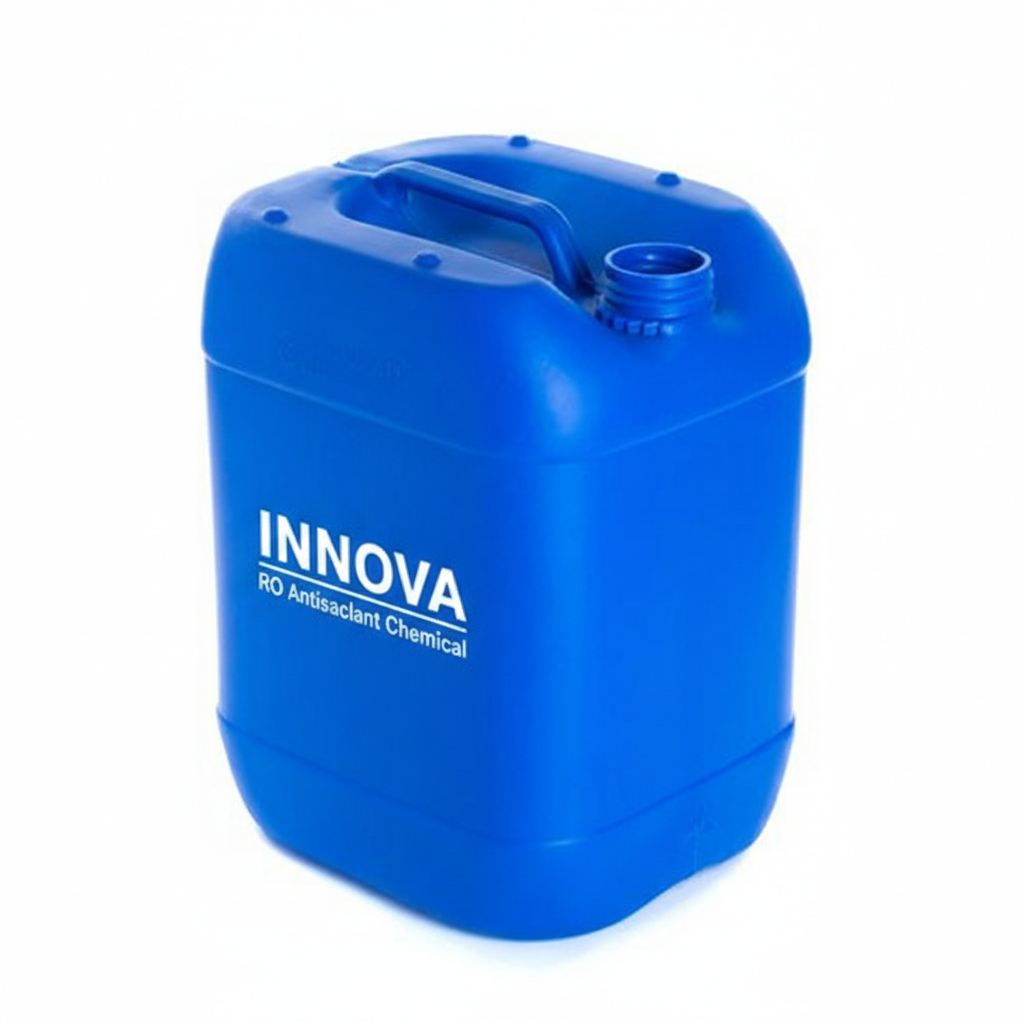
Industrial Grade RO Antiscalant & Antifoulant Chemicals in Canada
Not all scaling problems are the same. Carbonate scale forms when the Langelier Saturation Index rises above zero in the concentrate stream. Sulfate scale forms when calcium, barium or strontium ions exceed their solubility product. Silica does something entirely different — it polymerises into an amorphous glass-like deposit that no acid can remove. A single antiscalant formulation optimised for carbonate will underperform against silica; one optimised for silica may be insufficient for high sulfate loads. Choosing the right chemistry requires understanding which scaling mechanisms actually dominate in your specific water.
Innova Corporate (India) supplies a range of RO antiscalant chemicals for Canada built around three distinct formulation families — polymer-based, phosphonate-based and blended hybrid — so that every plant can match chemistry to its actual water profile. Polymer formulations work by crystal modification and dispersion: they distort the growing crystal lattice so that scale particles cannot anchor to the membrane surface. Phosphonate formulations work by threshold inhibition: they interrupt crystal nucleation at parts-per-million concentrations far below stoichiometric requirements. Blended formulations combine both mechanisms with specialised dispersants for silica and metal oxides.
Our RO antiscalant in Canada is a highly effective liquid pretreatment agent designed to control mineral precipitates and reduce particulate fouling. By maintaining clean membrane surfaces even in Canada's challenging water conditions, this product ensures longer operational run times and significantly extends the life of membrane elements — reducing both capital expenditure (CAPEX) and operational costs (OPEX). Whether for Reverse Osmosis (RO), Nanofiltration (NF), or Ultrafiltration (UF), our chemicals deliver consistent results across brackish water treatment, high-recovery systems and specialty filtration.
Key Features & Strategic Advantages for Canada Plants:
- Superior Scale Control: Effectively manages Calcium Carbonate up to LSI +3.0, Calcium Sulfate, Barium Sulfate, and Strontium Sulfate across the full saturation range.
- Silica Polymerisation Control: Specialised dispersants interrupt silica polymerisation and keep it in a soluble or finely dispersed state even at high recovery.
- Softener Alternative: Delivers excellent results as a low-maintenance replacement for traditional softener filters — eliminating salt consumption, regeneration water and resin maintenance.
- Potable Water Certified: Classified and safe for use in systems producing drinking water when dosed at recommended levels.
- Wide Compatibility: Fully compatible with all leading RO, NF and UF membranes, plus downstream coagulants and post-treatment chemicals.
- Metallic Oxide Tolerance: High tolerance to aluminium and iron oxides, preventing metallic fouling from coagulant residuals and naturally occurring metals.
- Operating Flexibility: Effective over a broad pH range and can be fed neat (concentrated) or diluted up to 10% with RO permeate.
- Particulate Dispersion: Acts as a powerful dispersant to keep silt, clay and organic foulants from adhering to the membrane surface.
Choosing the Right Formulation for Canadian Feedwater:
- High LSI Water (Carbonate Scaling Risk): Polymer or phosphonate formulations with high LSI tolerance. Common where groundwater is hard and alkaline, or where recovery rates concentrate carbonate ions above saturation.
- High Sulfate Water (Sulfate Scaling Risk): Formulations with high SDSI tolerance for calcium, barium and strontium sulfate. Selection depends on the specific sulfate species present in the water analysis.
- High Silica Water: Dedicated high-silica formulations with specialised dispersants. Standard antiscalants do not control silica effectively even at elevated doses.
- Mixed Scaling Risk: Blended hybrid formulations that combine polymer, phosphonate and silica dispersant mechanisms in one product.
- Surface Water with Organics: Formulations with enhanced particulate dispersion to handle silt, clay, humic substances and other suspended matter.
- High-Recovery Systems: Concentrated formulations that maintain effectiveness as ion concentrations rise sharply through the RO train.
Dosing Based on Concentrate, Not Feed: The correct antiscalant dose is calculated by looking at the saturation indices in the concentrate stream, not the feedwater. As water passes through the membrane, dissolved ions concentrate by a factor of three to five times or more depending on recovery. Carbonate, sulfate and silica that are well below saturation in the feed may be far above saturation in the reject. Our technical team calculates the required dose by modelling your specific water analysis, recovery rate, temperature and pH, ensuring that no scale species exceeds its critical saturation point anywhere in the system.
Strategic Benefits Delivered to Canadian Plants:
At Innova Corporate, we offer various specialised types of RO antiscalants tailored to specific water chemistries found in the Canadian region. Our technical team can assist you in selecting the precise formulation to ensure your system operates at peak recovery rates with minimal downtime — whether your priority is carbonate control, sulfate protection, silica dispersion or a combined program.
Frequently Asked Questions — RO Antiscalant Chemicals in Canada
1. What is the difference between polymer, phosphonate and blended antiscalants?
Polymer antiscalants work by crystal modification and dispersion. They distort the growing crystal lattice so scale particles cannot attach to the membrane. Phosphonate antiscalants work by threshold inhibition, interrupting crystal nucleation at very low concentrations. Blended formulations combine both mechanisms along with specialised dispersants for silica and iron. The right choice depends on your feedwater chemistry, especially the saturation indices and the presence of silica or metals. We recommend based on your actual water analysis rather than a generic preference.
2. What is LSI and how does it affect antiscalant dosing in Canada?
LSI stands for Langelier Saturation Index. It measures whether water is likely to deposit or dissolve calcium carbonate. A positive LSI means the water is supersaturated and will tend to form scale. Many Canadian groundwater sources sit between LSI +0.5 and +2.5, and RO systems concentrate this further in the reject stream. Antiscalant extends the maximum allowable LSI — typically up to +2.5 or +3.0 depending on the formulation. If your feedwater analysis shows a positive LSI, you need antiscalant to prevent carbonate scale. The exact dose depends on how high the LSI will be in the reject.
3. What is SDSI and why does it matter for sulfate scale?
SDSI stands for Stiff and Davis Saturation Index, which is used for high-salinity waters where LSI is not accurate. Sulfate scales — calcium sulfate, barium sulfate and strontium sulfate — are controlled by comparing the ion product against the solubility constant. When the sulfate concentration exceeds saturation, scale forms unless antiscalant is present. Different formulations have different sulfate tolerance limits. If your Canadian feedwater contains elevated sulfate, we recommend a formulation with high SDSI tolerance, especially for systems running at high recovery rates.
4. How does antiscalant handle silica scale in Canadian water sources?
Silica is a special case. Unlike carbonate and sulfate scales, silica polymerises rather than crystallises, forming an amorphous glass-like deposit that is extremely difficult to remove. Standard antiscalants do not control silica effectively. Our high-silica formulations use specialised dispersants that interrupt the polymerisation process and keep silica in a soluble or finely dispersed state. Canadian feedwater sources with elevated silica need a dedicated high-silica antiscalant, and dosing must be more generous than for carbonate-only protection.
5. Can a single antiscalant handle all scale types at once?
A well-designed blended formulation can handle multiple scale types simultaneously, but there are trade-offs. A formulation optimised for carbonate will not perform as well against silica at high concentrations. A formulation optimised for silica may underperform against high sulfate loads. The practical solution is to match the formulation to the dominant scaling risks in your water. If your water has multiple aggressive constituents, we can supply a custom blend that balances all the relevant protection mechanisms in one product.
6. How do I determine the correct antiscalant dose for my Canadian system?
Dose depends on the scaling potential of your concentrate stream, not just the feedwater. We calculate this using your complete water analysis, system recovery rate, temperature, pH and membrane type. The goal is to keep all potential scales below their saturation point in the reject. Typical doses range from 2 to 6 ppm for standard applications and up to 10 ppm for high-silica or mixed fouling. Because antiscalant is a small fraction of total operating cost compared to membrane replacement, it is better to dose slightly higher than to risk scaling.
7. What happens if I overdose antiscalant in my Canadian RO system?
Modest overdosing is harmless. Antiscalant passes through the membrane into the permeate at very low concentration, and the excess leaves with the concentrate. At typical doses of 2 to 10 ppm, the permeate concentration is far below any potable water concern. However, extreme overdosing is wasteful and can occasionally cause foaming in the permeate or interfere with downstream processes. The practical advice is: dose based on calculation, monitor normalized performance, and adjust only when data supports a change.
8. Does antiscalant degrade over time or require special storage in Canada?
Our liquid antiscalants have a shelf life of 24 months when stored in sealed original containers at temperatures between 5°C and 30°C. For Canadian winter transport to cold regions, protect from freezing. If the product freezes, thaw gradually at room temperature and stir before use — performance is unaffected. Avoid storing in direct sunlight or near incompatible chemicals. Keep containers closed when not in use to prevent contamination.
9. Can I switch antiscalant products without disrupting my RO system?
Yes, but the switch should be managed carefully. Before switching, ensure the membrane is clean and free of existing scale — antiscalant prevents new scale but does not remove existing deposits. Start the new product at the calculated dose and monitor normalized performance closely for the first two to four weeks. If any parameter drifts, adjust the dose rather than reverting immediately. We support Canadian clients through product transitions with dosing guidance and performance monitoring.
10. What documentation is provided with antiscalant chemical shipments to Canada?
Every Canadian shipment includes Material Safety Data Sheet (MSDS), Technical Data Sheet (TDS), Certificate of Analysis (COA) and recommended dosing guidelines. For potable water applications, we provide NSF compliance documentation and statements aligned with Health Canada guidelines and provincial drinking water regulations. Additional documentation can be prepared on request for specific provincial or workplace reporting requirements.