- 2B / BW Shalimar Bagh, Opp. BQ Market, Near DLF Mall New Delhi - 110088, India.
- :+91-9312-871-070

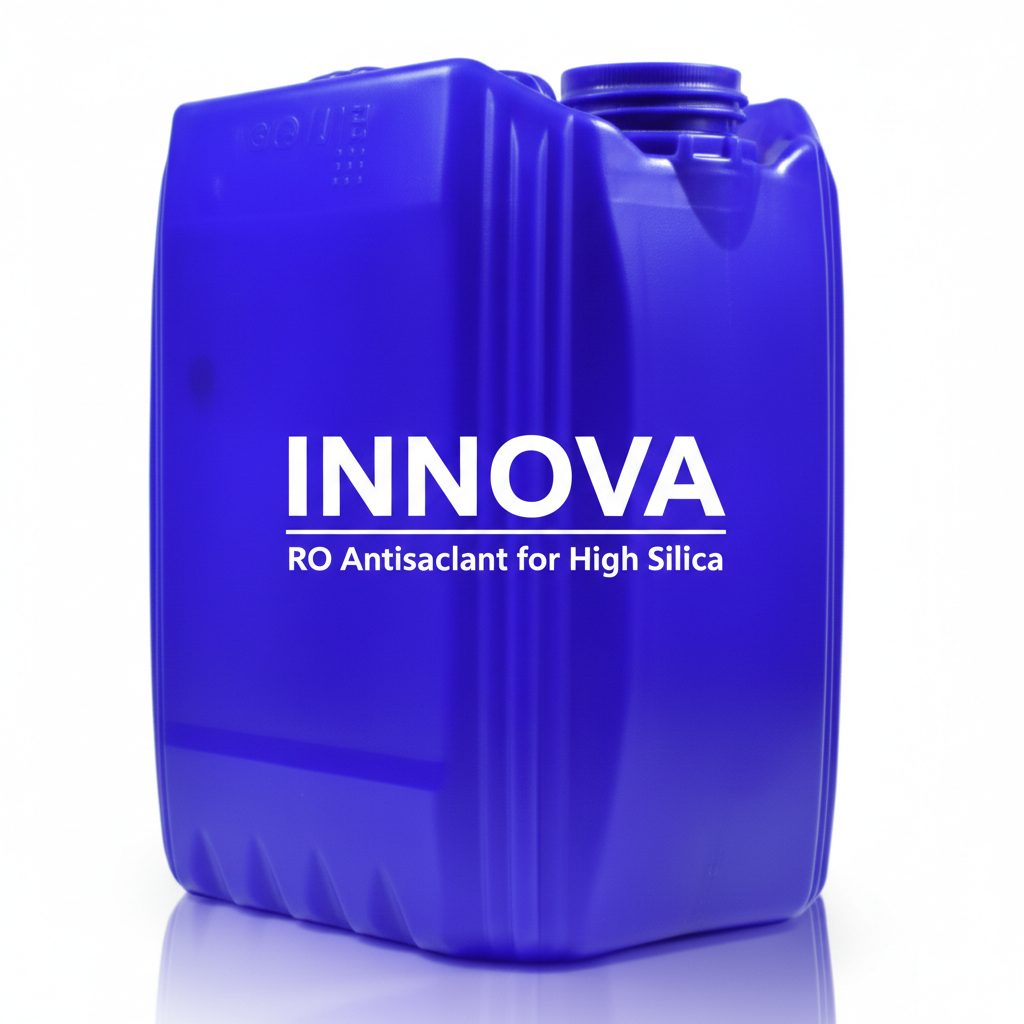
RO Antiscalant for High Silica & Metal Oxides in Hyderabad
Hyderabad's groundwater has a character of its own, and anyone running an RO plant here learns that lesson quickly. The granite and laterite formations that underlie much of the city's western and northern corridors steadily release dissolved silica into the aquifers, and borewells tapping these zones routinely show silica concentrations that would be considered high anywhere else in India. Innova Corporate (India) has formulated its RO Antiscalant High Silica in Hyderabad specifically around this local water reality, not as a generic product relabelled for the city. Every batch is produced with high-purity polymers and validated against real Hyderabad borewell samples before it ships.
Silica behaves differently from every other scale in RO treatment. Calcium carbonate and sulfate scales are crystalline — they can be dissolved by acid or alkaline CIP chemicals with predictable results. Silica is not. Once it polymerises past saturation, it forms an amorphous, glass-like deposit that bonds tightly to the membrane surface and resists almost all conventional cleaning chemistries. The only practical strategy is prevention: keeping silica below its polymerisation threshold throughout the entire membrane path, including the reject stream where concentration is highest. Our formulation uses a polymer architecture with a precisely tuned molecular weight distribution that interacts with silicic acid species and holds them in a soluble, non-reactive state even at the concentration factors typical of high-recovery Hyderabad plants.
There is a second reason silica control in Hyderabad is harder than it looks. The same geology that releases silica also releases iron. Raw borewell water in areas such as Patancheru, Medchal, Jeedimetla and the Genome Valley corridor frequently carries dissolved iron in the 0.5 to 1.0 ppm range. Iron oxidises on contact with air or chlorine, forms colloidal particles, and deposits on the membrane as a red-brown film. That film does more than block surface area — it creates nucleation sites where silica begins to polymerise much earlier than it would in clean conditions. A silica-only antiscalant will underperform in this environment. Our formulation addresses iron sequestration and silica inhibition together, so the membrane stays free of both deposit types in a single dosing stream.
Key Features & Strategic Benefits in Hyderabad:
- Critical Silica Control: Prevents complex silica-based scales that are often irreversible.
- Iron Fouling Sequestration: Effectively manages high iron content common in Hyderabad to prevent red-brown membrane staining.
- Optimized Recovery: Allows for higher water recovery rates even with high TDS and silica concentrations.
- Membrane Compatibility: Safe and compatible with all major brands of Polyamide, TFC, and NF membranes.
- Environmentally Responsible: Completely organic and biodegradable formulation.
- Maintenance Reduction: Drastically reduces the frequency of chemical cleanings and element replacements for Hyderabad plants.
- Carbonate & Sulfate Control: Simultaneously manages Calcium, Magnesium, Barium and Strontium scales alongside silica, eliminating the need for multiple antiscalant products.
- Colloidal Dispersion: Keeps silt, clay and organic particles suspended so they can be flushed out during normal concentrate flow rather than depositing on the membrane surface.
Dosage & Application Guidelines for Hyderabad:
High Silica RO Antiscalant should be dosed directly into the feed water line (after pretreatment). Standard dosage ranges from 2 ppm to 20 ppm, depending on Calcium Hardness, Iron, TDS, and Silica content in your Hyderabad facility:
- Moderate Hardness: 2-3 ppm is sufficient for alkalinity and hardness control.
- High Iron (0.5 - 1.0 ppm): Increase dosage by 5-7 ppm to effectively stabilize the system against Hyderabad's iron-rich groundwater.
- Extreme Silica (Up to 325 ppm): A dosage of approximately 10-15 ppm is recommended for full inhibition in the reject stream.
- Dosing Point: Inject upstream of the cartridge filter and after any chlorine removal step, ensuring complete mixing before the water reaches the membrane.
Where Hyderabad Plants Rely on This Formulation:
- Pharmaceutical Manufacturing: Stable silica and iron control for purified water loops and WFI systems, where any membrane drift affects product quality — critical for Genome Valley and Jeedimetla facilities.
- Food & Beverage Processing: Consistent permeate chemistry for CIP and process applications in Patancheru and Medchal food plants.
- Textile & Dyeing: Reliable water quality for shade matching and dye uptake in Balanagar and surrounding industrial estates.
- Boiler Feed & Cooling Tower Makeup: Extended membrane life for high-TDS borewell water feeding thermal systems.
- Drinking Water RO: Potable-safe formulation for municipal, hotel and community water systems across Hyderabad.
- ZLD & High-Recovery: Extended scale protection for systems operating above 75% recovery, where silica risk is most severe.
Storage & Handling: Store in original, tightly sealed containers in a cool and dry environment at your Hyderabad site. Keep away from direct heat and sunlight. Recommended storage temperature is between 5°C to 40°C. For customized dosing schedules based on your specific Hyderabad water analysis, please consult our Technical Data Sheet (TDS) or reach out to our technical team. The product has a shelf life of 12 months from the date of manufacturing when stored under recommended conditions.