- 2B / BW Shalimar Bagh, Opp. BQ Market, Near DLF Mall New Delhi - 110088, India.
- :+91-9312-871-070

Manufacturers, Exporters, Suppliers of RO Antiscalant Balls
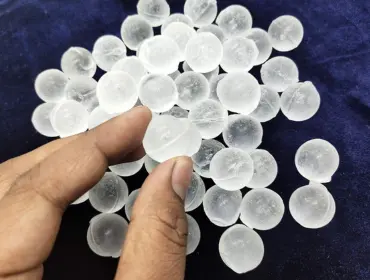
Slow-Release RO Antiscalant Balls in New Delhi (Siliphos)
New Delhi's water is among the hardest in India, and that reality shapes how every RO system in the city has to be designed and maintained. The Delhi Jal Board supply, drawn from the Yamuna river, Bhakra canal system and groundwater reserves, routinely carries hardness above 300 ppm as CaCO₃, and in many areas it crosses 500 ppm. Borewells across the NCR — from Okhla and Naraina to Rohini, Wazirpur and Bawana — tap into aquifers that are even harder, often loaded with iron and traces of heavy metals. For clinics, small laboratories, residential complexes and small commercial RO units across Delhi, this hardness creates a persistent scaling problem that eventually chokes membranes and raises operating costs. Traditional softeners handle hardness but require salt storage, resin maintenance and regular regeneration — a burden for small operations with limited space and manpower. Innova Corporate (India) offers its RO Antiscalant Balls in New Delhi as a practical alternative — slow-release Siliphos media that provides continuous scale protection without complex equipment.
These balls work on a simple but effective principle. Each ball is a compressed blend of food-grade polyphosphate that dissolves slowly as water passes through the housing. As it dissolves, it releases a small, consistent concentration of polyphosphate into the water — around 2-3 ppm. This polyphosphate does two jobs simultaneously. It forms a microscopic protective film on metallic surfaces — pipes, coils, tanks, geysers — shielding them from oxidative corrosion. And it interferes with the crystallisation of calcium and magnesium carbonate by holding the mineral ions in a soluble, non-adherent state. The result is that scale does not deposit on surfaces or on downstream RO membranes, and existing light scale gradually dissolves back into solution. For Delhi's residential societies with ageing plumbing, this gradual removal of existing scale is often as valuable as the prevention of new deposits.
Double-Action Protection: These balls utilize advanced polyphosphate technology to inhibit scale deposition and stop corrosion. They form a microscopic protective layer on metallic surfaces, shielding pipes and heating coils from oxidative damage. A low concentration of just 2-3 ppm is sufficient to stabilize New Delhi's feed water and prevent the hardening of minerals.
Why New Delhi Facilities Choose These Antiscalant Balls:
- Yamuna & DJB Water Compatibility: Performs reliably on Delhi Jal Board supply, Yamuna river water and NCR borewells — without reformulation when sources change.
- Softener-Free Operation: No salt storage, no resin replacement, no regeneration brine discharge — ideal for Delhi buildings where space is limited and discharge is regulated.
- Hard Water Performance: Effective at hardness levels above 500 ppm as CaCO₃, common across Okhla, Rohini and Bawana borewells.
- Dual Corrosion & Scale Control: Polyphosphate film protects pipes and coils while simultaneously preventing carbonate scale deposition on RO membranes.
- Existing Scale Removal: Gradually dissolves older iron oxide (brown) deposits common in Delhi's ageing water distribution networks.
- Corrosion-Safe on All Piping: Effective in galvanized steel, copper and plastic systems common across Delhi's mixed-age buildings.
- Maintenance-Free: Slow dissolution means months of protection without pumps, electricity, or daily chemical handling.
Technical Specifications
| Parameter | Value / Specification |
|---|---|
| Purity | 71.0% min |
| pH Value | 3.5 – 4.0 |
| Average Weight | 10 +/- 0.5 gm per ball |
| Dissolution Rate | 0.03 – 0.05 g / 24 hours |
| Water Insoluble | 0.06 % max |
| Heavy Metals (as Pb) | 8 ppm max |
| Iron Content | 40 ppm max |
Typical Installations Across New Delhi & NCR:
- Residential Societies & Apartments: Reliable scale protection for household RO units and community water systems across Rohini, Dwarka, Pitampura and Vasant Kunj.
- Clinics & Small Labs: Consistent water quality for dialysis units, pathology labs and diagnostic centres across Delhi's healthcare network.
- Commercial Buildings & Offices: Scale control for RO systems and kitchen equipment in Connaught Place, Nehru Place and Cyber City.
- Industrial Pre-Filter Housings: Standard 10-inch and 20-inch housings protecting RO membranes in Okhla, Naraina, Wazirpur and Bawana industrial estates.
- Hotels & Restaurants: Scale control for commercial RO systems and kitchen equipment across Delhi's hospitality belt.
- Older Buildings & Colonies: Gradual removal of existing iron oxide scale in ageing pipelines that still serve Delhi's heritage residential and commercial stock.
Storage & Handling: Store in a cool, dry place. These balls are designed for slow dissolution; ensure proper water flow through the housing for optimal results at your New Delhi site. For more details on shelf life and application, please refer to our Technical Data Sheet (TDS) and MSDS.