- 2B / BW Shalimar Bagh, Opp. BQ Market, Near DLF Mall New Delhi - 110088, India.
- :+91-9312-871-070

Manufacturers, Exporters, Suppliers of High Silica RO Antiscalant
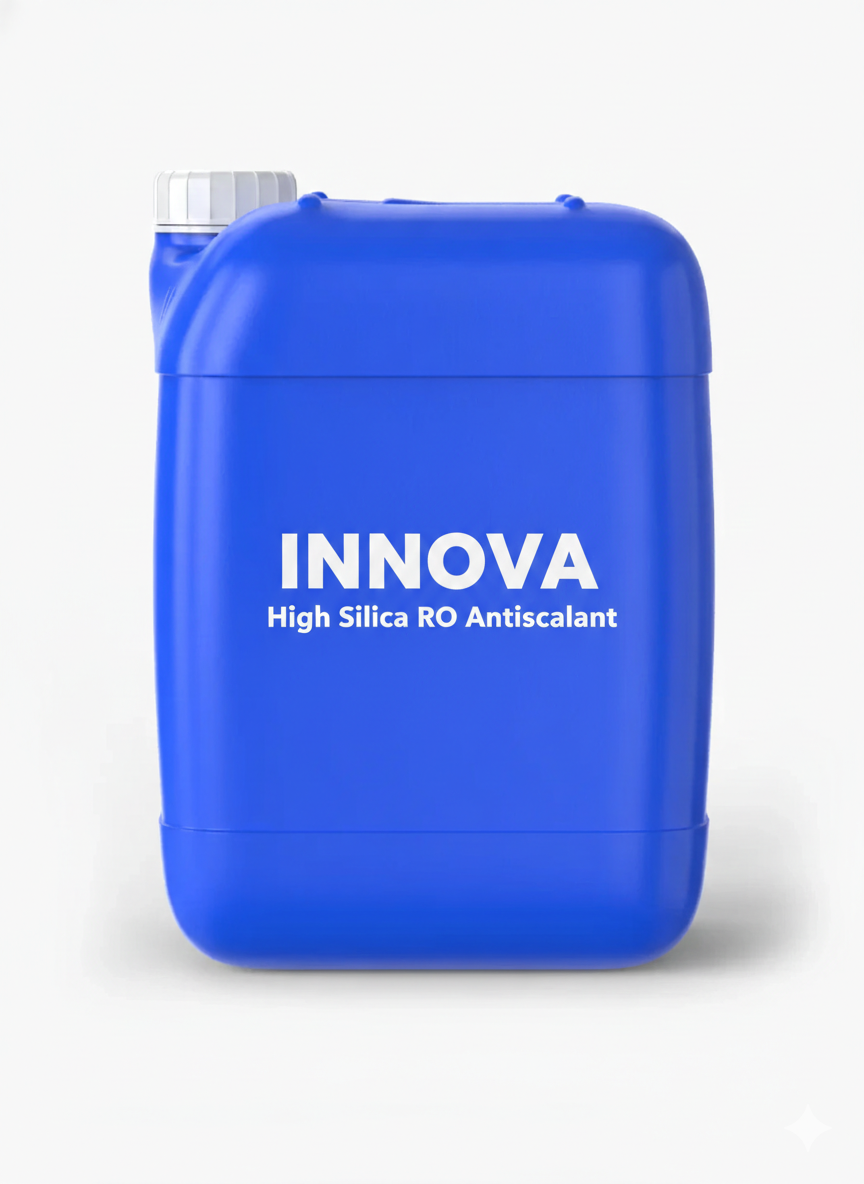
High Silica RO Antiscalant for Belgium Plants (Extreme Scale & Industrial Reuse Control)
Belgium's industrial RO plants face silica challenges from a specific set of water sources that differ from warmer regions. The Meuse river basin in Wallonia drains the Ardennes geological formation, contributing dissolved silica to plants in Liège, Namur, and Charleroi. The Scheldt basin in Flanders feeds Ghent, Antwerp, and downstream municipal sources. Industrial reuse and process water streams — particularly in Antwerp's petrochemical cluster and Ghent's heavy industry — can accumulate silica through multiple reuse cycles, pushing concentrations well above the typical 10 to 20 ppm range seen in Belgian surface water. Innova Corporate (India) supplies this high silica RO antiscalant for Belgium plants as a superior antifoulant designed for extreme scale control, and it is compliant with the EU Biocidal Products Regulation (BPR) and REACH requirements applicable to Belgium.
The formulation inhibits the deposition of inorganic scales, metal oxides, and high concentrations of silica. It is an essential pretreatment for Belgium water sources with an LSI up to +2.5, iron levels up to 1.5 ppm in the reject, and silica levels up to 325 ppm (mg/L) in the concentrate stream — covering even the most challenging industrial reuse scenarios. By preventing scale formation, it significantly extends membrane life and reduces unscheduled shutdowns, critical for the continuous 24/7 operations common in Antwerp's petrochemical cluster and Belgium's pharmaceutical manufacturing sector.
For Belgium specifically, cool-water efficacy is a critical differentiator. Belgium's surface water and municipal sources run between 5°C and 18°C year-round, and silica polymerisation kinetics are temperature-sensitive. Our formula maintains full efficacy from 5°C to 40°C, so Belgium plants do not need heated dosing systems or seasonal adjustment — no matter whether the source is a Meuse basin surface intake, a Scheldt basin municipal supply, or an industrial reuse stream at an Antwerp petrochemical facility.
Key Features & Strategic Benefits for Belgium Industries:
- EU BPR & REACH Compliant: Formulated to meet European regulatory requirements — documentation support available for Belgium facility audits, ESG reporting, AFSCA oversight, and EU GMP requirements.
- Extreme Silica Inhibition: Effectively controls silica scales up to 325 ppm in the concentrate stream — suitable for Belgium's industrial reuse scenarios in Antwerp's petrochemical cluster and Ghent's heavy industry.
- Iron Sequestration: Advanced formula prevents iron fouling from older industrial pipework and reuse streams — critical for Belgium's chemical and steel sectors.
- High Recovery Rates: Allows systems to operate at higher recovery levels without compromising membrane integrity — reduces water intake and brine discharge, aligned with Belgium's ESG and sustainability targets.
- Broad Spectrum Efficiency: Works across a wide range of pH, TDS, and high SDI (Silt Density Index) water — suitable for the Meuse basin, Scheldt basin, and industrial reuse sources across Belgium.
- Cool Water Performance: Full efficacy from 5°C to 40°C — no heated dosing or seasonal adjustment required for Belgium plants.
- Cost Optimisation: Low dosage requirements (2 to 20 ppm) deliver significant operational savings for Belgium plants — lower chemical consumption, lower downtime, longer membrane life.
- Environmental Safety: Fully organic and biodegradable formulation — compliant with EU discharge norms and supporting Belgium's environmental reporting requirements.
Recommended Applications in Belgium: Pharmaceutical manufacturing in Antwerp, Brussels, and Liège requiring ultrapure water for EU GMP compliance; Belgian brewing industry across Flanders and Wallonia where silica affects process consistency; food processing facilities under AFSCA oversight; chemical plants in the Antwerp petrochemical cluster; steel and heavy industry in Ghent, Liège, and Charleroi; cooling tower systems across Belgium where silica scale affects heat transfer; and municipal water treatment plants in Wallonia and Flanders drawing from Meuse and Scheldt sources.
Application & Dosage for Belgium Plants: The product should be dosed directly into the RO feed water tank or line after pretreatment and before the high-pressure pump. Typical dosage ranges from 2 ppm to 20 ppm, depending on the specific water chemistry — calcium hardness, alkalinity, and silica content. For water with elevated iron (0.5 to 1.0 ppm), a dosage of 5–7 ppm is recommended to ensure full stabilisation. For potable applications in Belgium, the maximum dosage is capped at 10 ppm per EU Drinking Water Directive requirements. Our technical team provides free dosage calibration based on your water analysis report — including Langelier Saturation Index, silica saturation, and iron assessment.
Storage & Stability: Store in original, tightly sealed containers in a cool, dry environment at your Belgium facility. Protect from direct sunlight and heat sources to maintain chemical potency. Use appropriate PPE during handling. For detailed application guidelines and safety protocols, refer to the Technical Data Sheet (TDS) and Material Safety Data Sheet (MSDS) — both compliant with EU regulatory documentation requirements.
Export & Technical Support for Belgium: We ship regularly to the Port of Antwerp-Bruges, Europe's second-largest port, with onward transport to Brussels, Ghent, Liège, Bruges, Charleroi, and other industrial cities across Belgium. All shipments include complete customs documentation, MSDS, and TDS. Our technical team provides free dosage calibration tailored to your plant's water chemistry, industry, and EU regulatory requirements — including compliance support for EU BPR, REACH, AFSCA, EU GMP, and EU Drinking Water Directive audits.