- 2B / BW Shalimar Bagh, Opp. BQ Market, Near DLF Mall New Delhi - 110088, India.
- :+91-9312-871-070

Manufacturers, Exporters, Suppliers of RO Dechlorination Chemicals
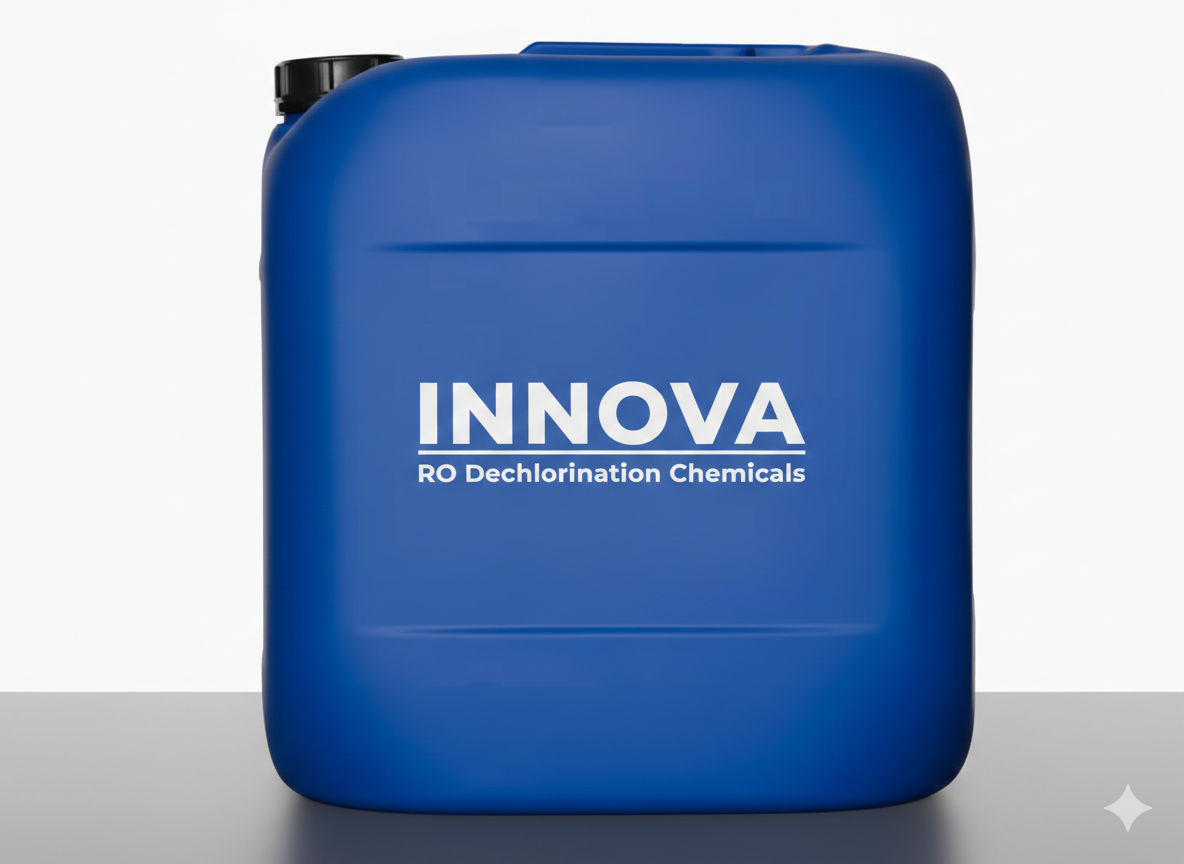
RO Dechlorination Chemicals (Oxidizing Agent Neutralizer for TFC & Polyamide Membranes)
Chlorine doesn't announce itself. It doesn't create visible scale, doesn't raise pressure drop, and doesn't show up in a routine TDS reading. But underneath, it silently attacks the polyamide active layer of your RO membranes — and by the time you notice rejection dropping or permeate TDS rising, the damage is already permanent. Innova Corporate (India) manufactures high-purity RO Dechlorination Chemicals specifically engineered to stop this invisible damage before it starts.
Our liquid de-chlorinator is a concentrated, stabilised reducing agent that rapidly neutralises residual free chlorine and chloramines in the feedwater — upstream of the RO membrane. It is designed for plants that deal with chlorinated municipal supply, pre-chlorinated borewell water, or any application where pretreatment oxidation control is critical to membrane survival.
Unlike powdered sodium metabisulfite that requires on-site mixing, inconsistent dissolution, and careful handling, our liquid formulation delivers uniform dosing precision, faster reaction kinetics, and lower handling risk. The result: stable membrane performance, protected rejection rates, and dramatically reduced risk of unexpected membrane replacement.
Key Features & Strategic Advantages:
- Rapid Neutralization: Stabilised formula acts within seconds of injection, neutralising free chlorine before it reaches the membrane surface.
- Critical Membrane Protection: Shields Polyamide and Thin Film Composite (TFC) membranes against oxidative degradation and irreversible chemical burning.
- Liquid Precision: Unlike conventional powders, our liquid formula is easy to handle, store, and dose with high volumetric accuracy — no mixing errors, no undissolved residue.
- Enhanced Stability: Significantly more stable than traditional sodium bisulfite solutions, with a longer effective shelf life.
- System Longevity: Prevents premature membrane replacement costs by eliminating the leading cause of irreversible membrane failure.
- Cost-Effective Dosage: Low dosage requirements (3–15 ppm) reduce overall chemical consumption and handling frequency.
- Chloramine Control: Effective against both free chlorine and combined chloramines — a critical advantage for municipal water sources.
- Potable Water Compliant: Formulated with ingredients safe for drinking water applications, including municipal and packaged water plants.
- Universal Membrane Compatibility: Safe for use with all major TFC, Polyamide, and NF membranes.
- No By-product Interference: Reacts cleanly without introducing hardness, TDS, or interfering ions into the treated stream.
Technical Specifications
| Parameter | Value / Description |
|---|---|
| Product Type | Liquid RO Dechlorination Chemical |
| Appearance | Clear, colourless liquid |
| Odour | Mild, characteristic — non-offensive |
| pH (1% solution) | 3.0 to 5.0 |
| Specific Gravity (at 25°C) | 1.00 to 1.15 |
| Water Solubility | Completely soluble in all proportions |
| Active Content | 20% to 40% (varies by variant) |
| Recommended Dosage | 3–15 ppm (based on residual chlorine level) |
| Reaction Time | Near-instant (within seconds of injection) |
| Storage Temperature | 5°C to 40°C — protect from direct sunlight |
| Shelf Life | 24 months from date of manufacturing |
| Packaging Options | 5L, 20L, 50L, 200L HDPE drums & IBC tanks |
Application & Dosing Guidelines:
The dosage depends on the residual chlorine level in the feedwater and the required contact time. Typically, dosing ranges from 3 ppm to 15 ppm.
- Injection Point: Should be dosed as close to the RO system as possible (for example, upstream of the cartridge filter) to minimise the residence time between neutralisation and membrane entry.
- High Chlorine Strategy: If free chlorine is high, dose de-chlorinator prior to antiscalant injection — as residual chlorine can oxidise and neutralise the effectiveness of antiscalants.
- Safe Mixing: Avoid mixing neat (concentrated) de-chlorinator and antiscalant directly due to pH differences; ensure dosing points are properly spaced to prevent chemical incompatibility.
- Verification: Test free chlorine downstream of the dosing point using a DPD test kit. A reading of 0.0 ppm indicates complete neutralisation.
Applications
| Industrial RO Plants | Textile, pharmaceutical, food processing, and power generation units |
| Municipal Water Treatment | Dechlorination of chlorinated municipal supply before RO |
| Pretreatment Systems | Chlorine removal upstream of RO, NF, and UF membranes |
| Food & Beverage | Process water dechlorination for bottling and CIP systems |
| Pharmaceutical | Purified water systems and WFI pretreatment |
| Drinking Water Plants | Municipal and packaged drinking water RO plants |
| Hospital & Hospitality | Central RO plants for hospitals, hotels, and large campuses |
| Desalination Pretreatment | Chlorine control upstream of SWRO and BWRO systems |
Storage & Safety: Always wear proper safety gear — including splash goggles, chemical-resistant gloves, and a lab coat — during handling and dosing. In case of skin contact, wash immediately with plenty of water. For eye contact, flush with fresh water for at least 15 minutes and seek medical attention. Store in original sealed containers in a cool, dry, well-ventilated area away from direct sunlight, heat sources, and incompatible chemicals (strong oxidizers, acids, alkalis).
*Note: As a company policy, Innova Corporate recommends consulting our service engineers for precise dosage requirements based on your specific water chemistry and chlorine load.
Why Choose Innova Corporate
| Manufacturing Expertise | In-house production with strict quality control at every stage |
| Global Export Network | Serving Middle East, Africa, and Southeast Asia with reliable logistics |
| Technical Support | Free dosing guidance and chlorine load assessment from our Delhi team |
| Custom Formulations | Tailor-made active content percentages for unique plant requirements |
| Bulk Supply Capability | Consistent stock availability for high-volume industrial buyers |
| Competitive Pricing | Factory-direct rates with transparent, no-hidden-cost invoicing |
Pricing & Supply
| Starting Price | From ₹250 per litre (bulk order slabs apply) |
| Custom Pricing | Special rates for 200L+ drums, IBC tanks, and export consignments |
| Minimum Order Quantity | 20 litres (sample quantities available on request) |
| Delivery Timeline | Pan-India dispatch within 3–5 working days |
| Payment Terms | Flexible options for regular and export buyers |
| Export Packaging | UN-approved HDPE drums & IBC totes for international shipping |
Dosing & Handling Guidelines
| Dosing Point | Injected into RO feedwater upstream of the cartridge filter |
| Dilution | Can be dosed neat or diluted with demineralised water |
| Dosing Equipment | Standard chemical dosing pumps (PP/PVC/PVDF wetted parts) |
| Mixing with Antiscalant | Dose upstream of antiscalant with adequate spacing — do not mix neat |
| Verification | Test free chlorine downstream with DPD kit; target 0.0 ppm |
| Storage | Store in a cool, dry, ventilated area away from direct sun |
Frequently Asked Questions (FAQ)
| Q1. What are RO Dechlorination Chemicals? | RO Dechlorination Chemicals are reducing agents — most commonly liquid or powder formulations based on Sodium Metabisulfite — dosed into RO feedwater to instantly neutralise residual free chlorine and chloramines before they reach the membrane. This prevents irreversible oxidation damage to Thin Film Composite (TFC) and Polyamide RO membranes. |
| Q2. Why is chlorine harmful to RO membranes? | TFC and Polyamide membranes are highly sensitive to oxidizers. Even 0.1 ppm of residual free chlorine can begin degrading the membrane's active polyamide layer, causing loss of salt rejection, increased TDS in permeate, and permanent membrane failure within weeks. Unlike scaling, chlorine damage is irreversible. |
| Q3. What is the recommended dosage of dechlorination chemical? | Typical dosing ranges from 3 to 15 ppm depending on the residual chlorine level in the feedwater. A general rule of thumb is roughly 1.5 to 2 parts of de-chlorinator per 1 part of free chlorine. Free site-specific dosing guidance is provided by our technical team. |
| Q4. How do I test if chlorine is fully neutralized? | Use a standard DPD or colorimetric chlorine test kit on the feedwater downstream of the dosing point. A reading of 0.0 ppm free chlorine indicates complete neutralisation. We recommend testing daily and maintaining a small residual margin of de-chlorinator. |
| Q5. Should de-chlorinator be dosed before or after antiscalant? | If free chlorine is present, dose de-chlorinator first, then antiscalant downstream. Residual chlorine can oxidise and reduce the effectiveness of many antiscalants, so proper dosing sequence is critical for plant performance. |
| Q6. Is dechlorination chemical safe for drinking water plants? | Yes. Our formulations use ingredients classified as safe for potable water applications when dosed as directed. It does not leave harmful residues in the treated water, making it ideal for municipal and packaged drinking water RO plants. |
| Q7. Can dechlorination chemicals be used for both RO and NF systems? | Yes. Our dechlorination chemicals are suitable for Reverse Osmosis (RO), Nanofiltration (NF), and Ultrafiltration (UF) pretreatment stages where chlorine-sensitive membranes are used. |
| Q8. What is the shelf life of RO Dechlorination Chemical? | The product has a shelf life of 24 months from the date of manufacturing when stored in its original sealed container at temperatures between 5°C and 40°C, away from direct sunlight and heat sources. |
| Q9. In what packaging sizes are dechlorination chemicals available? | We supply in 5L, 20L, 50L, and 200L HDPE drums, along with IBC tanks for bulk industrial requirements. Custom packaging is available for export orders. |
| Q10. Does this also remove chloramines? | Yes. Our liquid de-chlorinator is effective against both free chlorine and combined chloramines — a critical advantage when treating chloraminated municipal water supplies. |
| Q11. How is dechlorination chemical dosed into the RO system? | It is injected into the RO feedwater upstream of the cartridge filter using a standard chemical dosing pump with PP, PVC, or PVDF wetted parts. It can be dosed neat or pre-diluted with demineralised water. |
| Q12. Do you supply RO Dechlorination Chemicals outside India? | Yes. Innova Corporate (India) exports RO Dechlorination Chemicals to the Middle East, Africa, and Southeast Asia, with UN-approved export packaging and reliable logistics support. |