- 2B / BW Shalimar Bagh, Opp. BQ Market, Near DLF Mall New Delhi - 110088, India.
- :+91-9312-871-070

Manufacturers, Exporters, Suppliers of Silica Antiscalant High pH
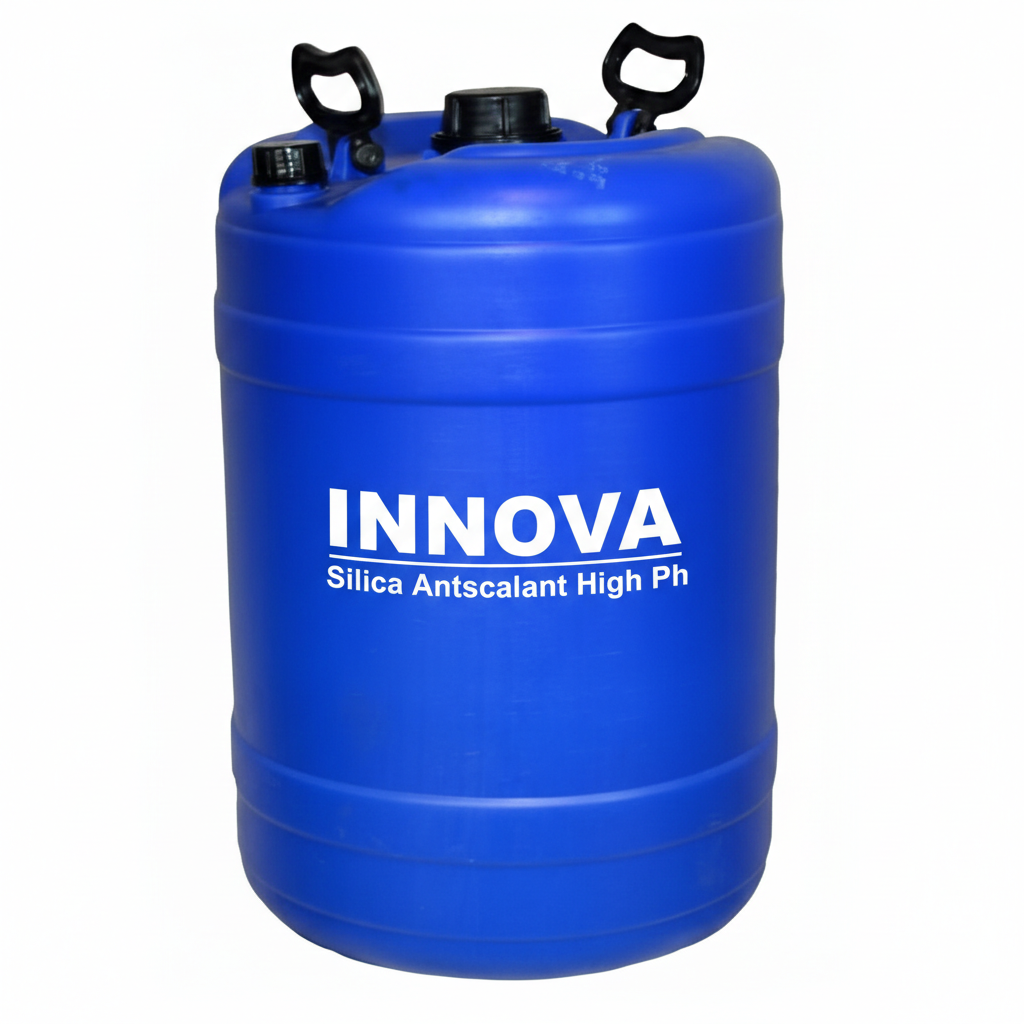
Silica Antiscalant in Israel (High pH)
Silica fouling behaves differently from every other scale an RO plant encounters. Carbonate, sulfate and phosphate scales form crystalline lattices that respond predictably to threshold inhibitors and acidic cleaning. Silica does neither. It polymerises into an amorphous, glass-like deposit that adheres tenaciously to the membrane surface and cannot be removed by standard acid cleaning. In fact, trying to remove silica with aggressive chemistry often damages the membrane before it damages the deposit. This is why silica has to be managed through prevention rather than correction — and why the specific chemistry of your feedwater matters more for silica than for any other foulant.
Innova Corporate (India) is a specialised manufacturer and supplier of High pH Silica Antiscalants in Israel. Our advanced alkaline formulation is engineered to inhibit silica polymerisation at the molecular level, keeping silica in a soluble or finely dispersed state that passes through the membrane into the concentrate rather than depositing on the membrane surface. The chemistry is designed for the operating conditions that Israeli RO plants actually use — including the elevated pH ranges that improve silica solubility while requiring careful carbonate control, and the varying ionic strengths of brackish and treated feedwater sources across the country.
Our Silica Antiscalant in Israel is a high-performance alkaline product that is fully compatible with drinking water systems. By keeping silica in suspension, it prevents membrane plugging, reduces the frequency of chemical cleanings (CIP), and significantly extends the life of RO membranes in Israel. The formulation is designed for silica concentrations that would overwhelm standard antiscalants, including the elevated reactive silica levels found in deep brackish sources and the colloidal silica that appears after seasonal runoff events.
What distinguishes our approach is the way the formulation behaves at high ionic strength. Silica polymerisation kinetics change substantially as dissolved salts increase, and formulations that perform well in low-TDS water can lose effectiveness in the concentrated reject stream of a high-recovery system. Our chemistry is specifically developed to maintain silica dispersion across the full concentration range, from feed to reject, and across the temperature range typical of Israeli operations. This is particularly relevant where systems operate at recovery rates above 75 percent, where silica can concentrate by a factor of four or more.
Key Benefits & Salient Features for Israel:
- Superior Silica Control: Effectively manages high levels of reactive silica in Israel feed water across the full concentration range.
- Polymerisation Inhibition: Interrupts the silica condensation reaction at the molecular level, preventing formation of the glass-like deposits that resist acid cleaning.
- High Ionic Strength Performance: Maintains effectiveness in the concentrated reject stream of high-recovery systems, where simpler formulations lose potency.
- Membrane Protection: Prevents irreversible physical damage caused by sharp silica crystals abrading the membrane surface during cleaning or normal operation.
- Drinking Water Safe: Formulated with ingredients suitable for potable water applications and compliant with Israeli drinking water standards.
- Cost-Efficiency: Minimises downtime and reduces the need for expensive silica-specific cleaning cycles that rarely achieve full recovery.
- Temperature Stability: Maintains effectiveness across the seasonal temperature range of Israeli water sources, from cool winter groundwater to warm summer surface conditions.
Diagnosing Silica Fouling — What to Look For:
- Normalized Flow Decline: Permeate flow drops gradually but persistently and does not respond fully to standard acid CIP.
- Differential Pressure Pattern: Pressure drop rises more slowly than with organic or biological fouling, but does not reverse after cleaning.
- Autopsy Findings: A hard, glassy deposit visible on the membrane surface that does not dissolve in acid but may partially dissolve in strong alkali.
- Water Analysis: Reactive silica above 20 ppm in the feedwater combined with the fouling pattern above is a strong indicator.
- Recovery Rate Correlation: Fouling severity correlates with system recovery — higher recovery produces higher silica concentration in the reject and faster fouling.
- Seasonal Variability: If fouling accelerates during specific seasons, this may indicate colloidal silica from runoff or seasonal changes in feedwater composition.
Strategic Value Delivered to Israeli Plants:
Application & Dosage in Israel:
Dosage Range: The usual dosage for silica antiscalant ranges from 2–10 ppm. In severe conditions or smaller installations in Israel, this may increase up to 15 ppm. The correct dose is calculated based on the concentration of silica in the reject stream, not the feedwater, because silica concentrates three to five times through the RO train. We recommend consulting an Innova representative to determine the optimal dosage based on your water analysis.
Injection Point: Dose continuously into the RO feed stream after pretreatment and before the cartridge filter. For systems with variable feedwater composition, inline monitoring of silica concentration supports dose adjustment.
Storage: Store in original containers in a cool, dry place in Israel away from heat, flame, and direct sunlight. Israel's climate is generally suitable for storage in shaded warehouses, though summer heat in the Negev and Arava can push temperatures higher — in those regions, store in insulated or air-conditioned facilities.
Technical Support: Please refer to the Technical Data Sheet (TDS), Label, and MSDS for comprehensive details on safety and shelf life. Documentation aligned with Israeli Ministry of Health standards and the Israel Water Authority framework is available on request.
Frequently Asked Questions — High pH Silica Antiscalant in Israel
1. What is silica fouling and why is it different from other RO scales?
Silica fouling is different from carbonate, sulfate and phosphate scaling because silica does not crystallise — it polymerises. Carbonate and sulfate scales form ordered crystalline lattices that respond to threshold inhibitors and acidic cleaning. Silica forms amorphous, glass-like deposits that adhere tenaciously to the membrane surface and cannot be removed by standard acid cleaning. In fact, aggressive cleaning attempts often damage the membrane before they damage the deposit. This is why silica has to be managed through prevention rather than correction, and why antiscalant chemistry specifically designed for silica polymerisation is essential whenever reactive silica is present in the feedwater.
2. What is the difference between reactive silica and colloidal silica, and why does it matter?
Reactive silica is dissolved silica — silicic acid (H₄SiO₄) and silicate ions in true solution. It is what most antiscalants are formulated to control, and it is measured in standard water analysis. Colloidal silica is much larger — suspended particles of polymerised silica ranging from nanometres to microns in size. It does not dissolve, cannot be measured by standard silica analysis, and cannot be controlled by the same chemistry that handles reactive silica. Our formulation includes dispersants that handle both forms, but the correct dose and expected performance depend on knowing which form dominates in your specific feedwater.
3. How does high ionic strength affect silica polymerisation and antiscalant performance?
Silica polymerisation kinetics change substantially as dissolved salt concentration increases. In low-TDS water, silica remains soluble at higher concentrations and polymerises more slowly. In high-TDS water, the same silica concentration can polymerise faster because the dissolved ions catalyse the condensation reaction. This is why formulations that perform well in freshwater may lose effectiveness in the concentrated reject stream of a high-recovery system. Our chemistry is specifically developed to maintain silica dispersion across the full concentration range, from feed to reject, and to compensate for the increased polymerisation pressure in high-TDS conditions.
4. How does recovery rate affect silica scaling risk?
Recovery rate directly determines how much silica concentrates in the reject stream. At 50 percent recovery, silica concentrates by a factor of two. At 75 percent recovery, the factor is four. At 85 percent, it is nearly seven. Systems operating at higher recovery expose the membrane to exponentially higher silica concentrations in the reject stream, even if feedwater silica is moderate. This is why dose calculation must be based on the reject stream chemistry, not the feedwater. For high-recovery systems, we typically recommend doses in the upper end of the range and may recommend a dedicated high-silica formulation.
5. How do I know if my RO system has silica scaling rather than another type of fouling?
Silica scaling has a distinctive signature. Permeate flow declines gradually but persistently and does not respond fully to standard acid CIP. Differential pressure rises more slowly than with organic fouling but does not reverse after cleaning. Autopsy of a fouled element reveals a hard, glassy deposit that does not dissolve in acid but may partially dissolve in strong alkali. If your feedwater analysis reports reactive silica above 20 ppm and your system shows this pattern, silica scaling is likely contributing to performance loss. We help clients confirm diagnosis through water analysis and autopsy findings.
6. Can silica be removed from a fouled membrane, or does the membrane need to be replaced?
Partial silica removal is sometimes possible with specialised alkaline cleaning at high pH, extended contact time, and elevated temperature. But full recovery is rarely achieved, and aggressive cleaning can damage the membrane. This is why prevention is the primary strategy — antiscalant that keeps silica in solution during normal operation is far more effective than trying to remove deposits after they form. If silica scaling has already occurred, we can provide a specialised cleaning protocol that may recover partial performance, but the practical goal is to prevent future scaling through proper antiscalant dosing.
7. What is the optimal pH range for silica control?
Silica solubility increases significantly at higher pH. At neutral pH around 7, dissolved silica saturates at roughly 100 to 140 ppm depending on temperature. At pH above 8.5, this limit rises to 300 ppm or more because the silicate ion becomes more stable in solution. Our high pH silica antiscalant is designed to work across this elevated pH range. The trade-off is that high pH increases carbonate scaling risk, which our formulation addresses alongside silica control. In practice, the optimal pH depends on the specific feedwater composition and system design, and we help clients determine the target pH for their application.
8. How do temperature fluctuations affect silica antiscalant performance?
Temperature affects both silica solubility and antiscalant kinetics. Warmer water increases silica solubility, which helps prevent scaling, but it also accelerates polymerisation kinetics, which is the reaction we are trying to inhibit. Colder water reduces polymerisation kinetics but also reduces solubility, so saturation is reached at lower silica concentrations. Our formulation is tested across the seasonal temperature range of Israeli water sources and maintains effectiveness in both warm and cool conditions. For systems with significant seasonal variability, we may recommend seasonal dose adjustment.
9. Is the high pH silica antiscalant safe for drinking water applications in Israel?
Yes. Our high pH silica antiscalant is formulated using food-grade raw materials and is suitable for potable water applications when dosed at recommended levels. We provide documentation aligned with Israeli Ministry of Health drinking water standards and the Israel Water Authority regulatory framework. After treatment, the antiscalant remains on the feed side of the membrane and exits with the concentrate, so permeate quality is unaffected. For potable water applications, we can provide additional documentation on residual concentrations and verification procedures.
10. How do you ship high pH silica antiscalant to Israel?
We ship from Indian ports to Haifa, Ashdod and Eilat. All shipments include commercial invoice, packing list, certificate of origin, MSDS and any certificates required by Israeli Customs and the Standards Institution of Israel. High pH formulations are alkaline materials classified as corrosive depending on concentration and are packed in UN-approved containers with proper classification, labelling and dangerous goods documentation where required. We work with freight forwarders experienced in Israeli import procedures and can support clients through customs clearance and standards compliance.