- 2B / BW Shalimar Bagh, Opp. BQ Market, Near DLF Mall New Delhi - 110088, India.
- :+91-9312-871-070

Manufacturers, Exporters, Suppliers of RO Antiscalant Low pH
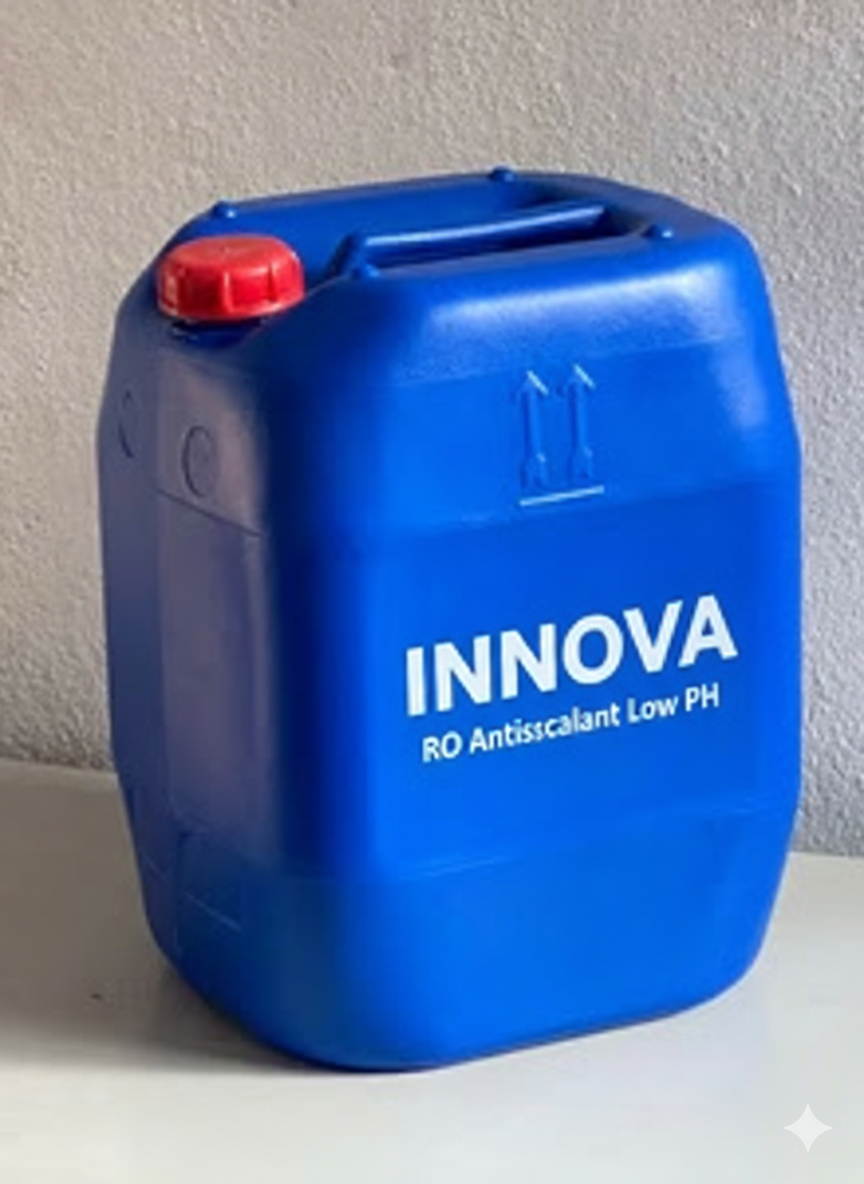
Low pH RO Antiscalant for Odisha (Acidic Broad Spectrum Formula)
Odisha's scaling problem shifts sharply with geography. The steel and power belt around Rourkela, Sambalpur and Jharsuguda draws from the Brahmani and IB river systems — hard water with elevated sulphates that form dense calcium sulphate scale at moderate recovery. The alumina and process cluster at Dhenkanal and Angul pulls from mixed surface and borewell sources with consistently high hardness. Coastal units near Balasore, Paradip and Berhampur deal with saline intrusion that pushes TDS and sulphate levels higher than inland plants. In each case, the scale is acidic-dominant — which is exactly where alkaline chemistries struggle. Our low pH RO antiscalant is formulated for the sulphate-heavy, hard-water conditions that dominate Odisha's industrial feed sources.
The chemistry works at the nucleation stage. When dissolved salts cross saturation — which happens quickly in hard Odisha borewell water at moderate recovery — they first form microscopic crystal nuclei before depositing on the membrane. This formulation interferes at that exact point, distorting crystal growth and keeping particles suspended in the bulk stream where they exit with the concentrate. The acidic nature of the product makes it naturally suited to high-saline and high-TDS streams, where alkaline chemistries struggle with sulphate scales. For Odisha plants that run continuously and cannot afford unplanned shutdowns, that stability is what keeps recovery from quietly slipping month after month.
What This Antiscalant Delivers for Odisha Plants:
- Broad Inorganic Coverage: Controls calcium carbonate, calcium sulphate, barium sulphate, strontium sulphate and mixed metal oxides that routinely appear in Odisha water — particularly sulphate-dominant scale in the Brahmani and IB belts.
- Flexible pH Window: Delivers stable performance between pH 6.0 and 10.0, so minor fluctuations in feed chemistry don't disrupt scale control.
- Built for Hard & Saline Water: Performs reliably in high-TDS and high-conductivity feed water — common in the coastal belt near Paradip and Balasore.
- Economical Dosage: Works effectively at just 1–6 ppm, keeping treatment costs predictable for continuous-operation Odisha plants.
- Instant Dissolution: Mixes completely and quickly in water, ensuring uniform distribution without settling or stratification in the dosing tank.
- Membrane Compatibility: Safe for polyamide, TFC and CTA membranes — no chemical attack even with round-the-clock dosing.
Technical Specifications:
| Appearance | Clear Liquid |
| pH (as is) | Less than 4.0 |
| Specific Gravity | 1.1 – 1.2 |
| Recommended Dosage | 1 – 6 ppm |
| Solubility | Easily soluble in water |
Dosage & Application: Inject continuously into the RO feed line downstream of pretreatment and upstream of the cartridge filter. For most Odisha installations, the working dose falls between 2 and 6 ppm, set by feed hardness, TDS, sulphate and recovery. Plants drawing from the Brahmani belt or coastal Paradip sources may need the upper end of the range. We recommend a feed water analysis before finalising the dose for your Odisha plant.
Storage & Safety: Keep the product in its original sealed container, stored in a cool, dry, shaded area at your Odisha site, away from direct sun and heat. Full safety data and application support are covered in the Technical Data Sheet (TDS) and Material Safety Data Sheet (MSDS).