- 2B / BW Shalimar Bagh, Opp. BQ Market, Near DLF Mall New Delhi - 110088, India.
- :+91-9312-871-070

Manufacturers, Exporters, Suppliers of RO Antifoulant
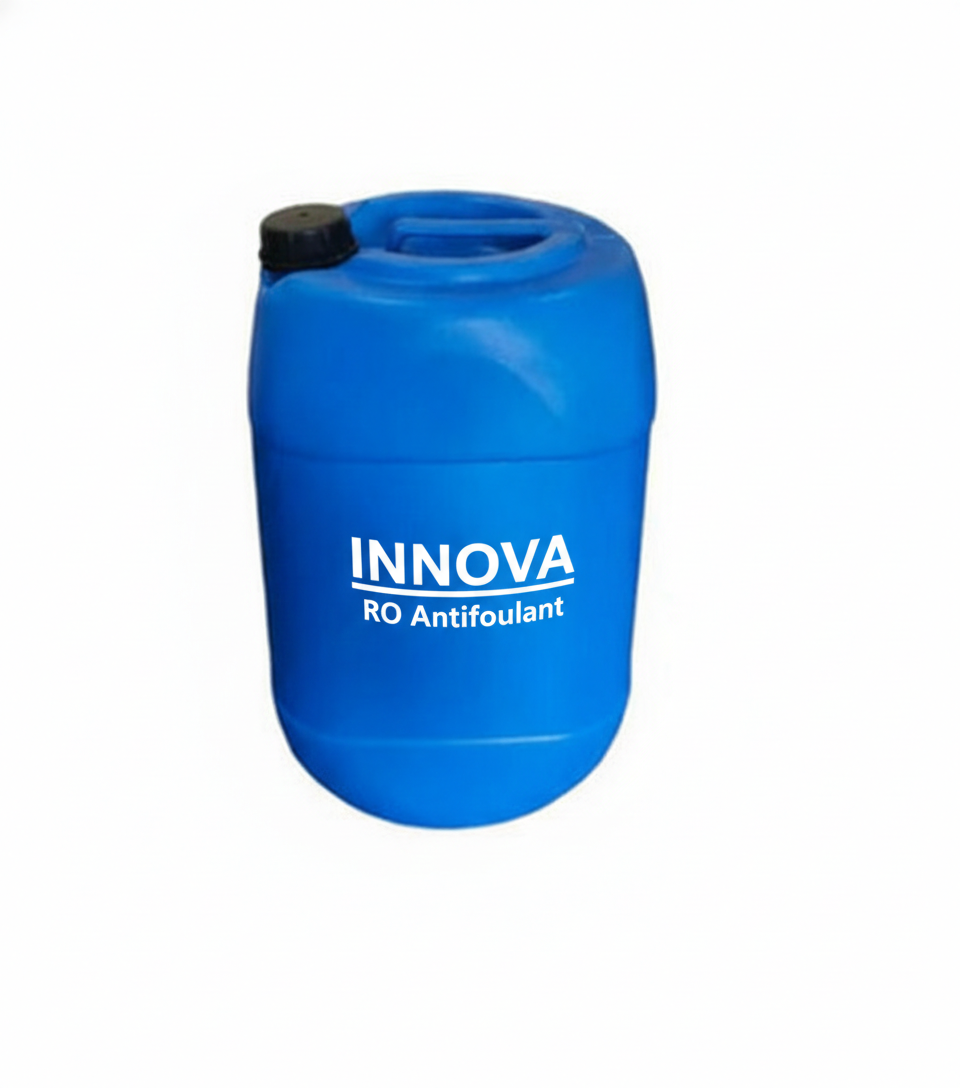
Super-Threshold RO Antifoulant & Antiscalant in Sweden
Innova Corporate (India) is an ISO 9001 certified manufacturer and exporter of high-performance RO antifoulants for Sweden. Our formulations are built around a super-threshold mechanism — rather than merely inhibiting scale formation at saturation, they stabilise supersaturated salt solutions well above their normal precipitation limits, allowing Swedish plants to operate at higher recovery rates without risking membrane fouling. The chemistry is tuned for Sweden's specific water conditions: soft granitic shield groundwater, Baltic brackish feedwater, Arctic cold-water operations and lake-fed surface sources with seasonal organic load.
Our RO antifoulant in Sweden acts as a powerful super-threshold agent, stabilising a wide spectrum of supersaturated salt solutions to prevent precipitation on the membrane surface. By minimising scaling risks in Sweden's unique water conditions, it eliminates the need for hazardous acid dosing — allowing for a safer work environment and achieving the highest possible plant conversion rates. This matters especially in Sweden, where environmental and workplace safety regulations under Arbetsmiljöverket and Naturvårdsverket place strict limits on chemical handling and discharge.
Technical Superiority: This formulation is exceptionally effective for feed water with an LSI (Langelier Saturation Index) up to +2.5, iron levels up to 1.2 ppm in reject, and high SDI (Silt Density Index). It provides a robust shield against common foulants found in Sweden's surface and groundwater, including sulfate salts, carbonate salts, calcium fluoride, iron oxides and silica. The super-threshold mechanism is particularly valuable for high-recovery Swedish systems, where ion concentrations in the reject stream rise sharply and conventional threshold inhibitors lose effectiveness.
Targeted Fouling Protection in Sweden:
- Sulfate & Carbonate Salts: Inhibits calcium, barium, strontium and magnesium scales across the full saturation range — critical for Baltic brackish water where sulfate is elevated.
- Metallic & Silica Scale: Prevents calcium fluoride, iron and silica deposition common in Sweden's shield groundwater and mining water sources.
- Super-Threshold Stabilisation: Maintains stability at LSI up to +2.5 and iron concentrations up to 1.2 ppm in the reject stream — enabling higher recovery without scaling risk.
- High Recovery Rate: Maintains membrane flux and reduces energy consumption by keeping surfaces clean, supporting Sweden's energy efficiency priorities.
- Low Dosage Efficiency: Highly concentrated formula ensures cost-effectiveness for Swedish plants, aligning with the country's focus on chemical optimisation and reduced environmental footprint.
- Arctic Cold-Water Performance: Remains fully effective at 0°C to 8°C — essential for Norrland operations where feedwater is cold year-round.
- Universal Compatibility: Safe for use with all major brands of Polyamide and TFC membranes, and compatible with the full range of pretreatment chemistries used in Swedish plants.
- Acid-Dosing Elimination: Removes the need for hazardous acid injection, improving workplace safety and simplifying operations.
- ISO 9001 Certified Manufacturing: Every batch undergoes rigorous quality checks with full traceability from raw material to finished product.
Swedish Water Sources & Antifoulant Selection:
- Baltic Brackish Coastal Water: Elevated sulfate, magnesium and organic load. Super-threshold formulation with high sulfate tolerance.
- Granitic Shield Groundwater: Soft, low-alkalinity water with iron and manganese. Formulation with metal sequestration and cold-water stability.
- Lake and River Surface Water (Mälaren, Vänern, Norrland lakes): High natural organic matter (humic and fulvic acids) with seasonal variability. Antifoulant with organic dispersion.
- Arctic Mining Water (Kiruna, Gällivare): Cold feedwater with dissolved iron, manganese and sulfate from ore bodies. Cold-optimised formulation with metal tolerance.
- Pulp and Paper Mill Water: Mixed mineral and organic load from process streams. Formulation with particulate dispersion and lignin tolerance.
- Municipal Drinking Water: Variable composition with strict quality requirements. Formulation aligned with Livsmedelsverket and EU drinking water directives.
- High-Recovery Industrial Systems: Super-threshold formulation that maintains effectiveness at extreme concentration factors.
Strategic Benefits Delivered to Swedish Plants:
As a globally recognised RO antifoulant exporter serving Sweden, Innova Corporate ensures that every batch undergoes rigorous quality checks. Whether you are dealing with challenging Baltic brackish water, hard shield groundwater, cold Arctic feedwater or high-TDS mining sources in Sweden, our chemicals provide the stability your plant needs for uninterrupted operation. Full documentation aligned with REACH, CLP, Livsmedelsverket, Naturvårdsverket and Arbetsmiljöverket requirements is provided with every shipment.
Storage & Support: Keep in original containers in a cool, dry place away from direct sunlight at your Sweden facility. For northern Sweden, protect from freezing during transport and storage. If the product freezes, thaw gradually at room temperature and stir before use — performance is unaffected. For detailed dosing charts and water analysis support, please refer to our Technical Data Sheet (TDS) or contact our technical experts.
Frequently Asked Questions — RO Antifoulant in Sweden
1. What is the difference between RO antifoulant and RO antiscalant?
Antiscalant targets inorganic mineral scale — calcium carbonate, calcium sulfate, barium sulfate and silica. Antifoulant targets the organic and biological fraction — natural organic matter, humic and fulvic acids, proteins, polysaccharides, algae and bacterial biofilm. In practice, most Swedish RO systems face both types of fouling simultaneously because surface water sources carry mixed mineral and organic loads. Antiscalant and antifoulant are often dosed together as a combined program, with the antifoulant dispersing the organic fraction so that mineral scale inhibitors can function effectively.
2. Why does Sweden's natural organic matter content require special antifoulant chemistry?
Sweden's surface water sources — lakes, rivers and reservoirs — carry unusually high natural organic matter (NOM) because of the surrounding boreal forest and peatland ecosystems. This NOM is dominated by humic and fulvic acids, which are large, complex molecules that bind to membrane surfaces and form a gel-like layer. Unlike mineral scale, humic fouling does not respond well to acidic cleaning because the mechanism is adsorption rather than crystallisation. Our antifoulant is formulated with high-charge anionic polymers that compete with humic acids for membrane surface sites and keep them dispersed in the bulk water, so they pass through to the concentrate rather than depositing on the membrane.
3. How does the Baltic Sea seasonal algae cycle affect RO antifoulant performance?
The Baltic Sea experiences a pronounced seasonal algae cycle, with cyanobacteria and green algae blooms peaking in late summer when water temperatures are warmest and nutrients are available. During bloom periods, RO feedwater from Baltic coastal sources carries elevated algal organic matter — polysaccharides, proteins and cell fragments. This material forms a dense, sticky fouling layer on membranes that is difficult to remove with standard cleaning. Our antifoulant for Baltic coastal plants is formulated with dispersants specifically active against algal organic matter, keeping it in suspension and preventing adhesion to the membrane surface.
4. Can RO antifoulant handle paper mill effluent organics in Swedish plants?
Yes. Swedish pulp and paper mills generate process water streams that contain lignin derivatives, resin acids, polysaccharides and other wood-derived organics. These compounds are chemically distinct from humic substances but equally challenging for RO membranes because they adsorb strongly and form cohesive films. Our antifoulant for pulp and paper applications includes dispersants that specifically target lignin and resin-acid chemistry, keeping these organics suspended so they can be concentrated and discharged with the reject stream rather than fouling the membrane.
5. How does cold Swedish feedwater affect organic fouling?
Cold water changes organic fouling behaviour in two opposing ways. Lower temperatures reduce the rate of biological growth, so biofilm formation is slower than in warm climates. However, lower temperatures also reduce the solubility of humic substances and change the adsorption kinetics at the membrane surface, which can lead to faster organic deposition even without active biological growth. Our antifoulant is tested at 2°C to ensure that dispersant activity remains effective in the cold feedwater temperatures typical of Swedish operations, especially in northern regions where water may stay below 8°C year-round.
6. How do I know if my Swedish RO system has organic fouling?
Organic fouling has a distinct signature. Permeate flow declines steadily and salt rejection may drop faster than with mineral scaling because the organic layer affects both the surface charge and the transport properties of the membrane. Differential pressure rises gradually. Autopsy typically reveals a brown or dark-coloured gel-like deposit that dissolves in alkaline cleaning but not in acid. If your feedwater analysis reports high TOC (total organic carbon) or high colour, and your system shows these fouling signs, organic fouling is the likely cause. We help clients confirm diagnosis through water analysis and autopsy findings.
7. Is RO antifoulant compatible with RO antiscalant in a combined treatment program?
Yes, and in most Swedish plants both are needed. Antiscalant prevents mineral scale, antifoulant prevents organic deposition, and together they deliver complete membrane protection. The two products are typically dosed at separate injection points — antiscalant after pretreatment and before the cartridge filter, antifoulant slightly upstream where organic load is highest. Both chemistries are compatible with polyamide membranes and with each other. We supply combined programs with dosing guidance tailored to each plant's water chemistry.
8. How should RO antifoulant be dosed and stored in Sweden?
Typical antifoulant doses range from 2 to 8 ppm in the feed stream, with higher doses during seasonal algae blooms or after heavy rainfall when organic load spikes. Continuous dosing is recommended for systems with consistently high organic content, while intermittent dosing may suffice for seasonal spikes. Storage is simple in Sweden's climate — keep containers sealed between 5°C and 30°C, away from direct sunlight. Protect from freezing during transport to northern regions. Shelf life is 24 months under recommended conditions.
9. What is the correct dose for high-TOC Swedish lake water?
Dose depends on the TOC concentration, the specific character of the organic matter, the membrane type and system recovery. As a starting point, Swedish lake water with TOC between 5 and 10 ppm typically requires 3 to 5 ppm antifoulant. Water with TOC above 15 ppm, which is common in autumn after leaf fall and heavy rains, may need 6 to 8 ppm. Because organic character varies seasonally, we recommend monitoring TOC and normalized performance together, and adjusting dose based on actual fouling trends rather than a fixed schedule.
10. What documentation is provided with antifoulant shipments to Sweden?
Every shipment to Sweden includes Material Safety Data Sheet (MSDS) compliant with REACH and CLP requirements, Technical Data Sheet (TDS), Certificate of Analysis (COA) and dosing guidelines. For potable water applications, we provide documentation aligned with Livsmedelsverket requirements and EU drinking water directives. For discharge compliance, we supply information suitable for Naturvårdsverket reporting. For biocidal applications where relevant, BPR-compliant documentation is provided. Swedish-language summaries are available on request.