- 2B / BW Shalimar Bagh, Opp. BQ Market, Near DLF Mall New Delhi - 110088, India.
- :+91-9312-871-070

Manufacturers, Exporters, Suppliers of RO Membrane Cleaner
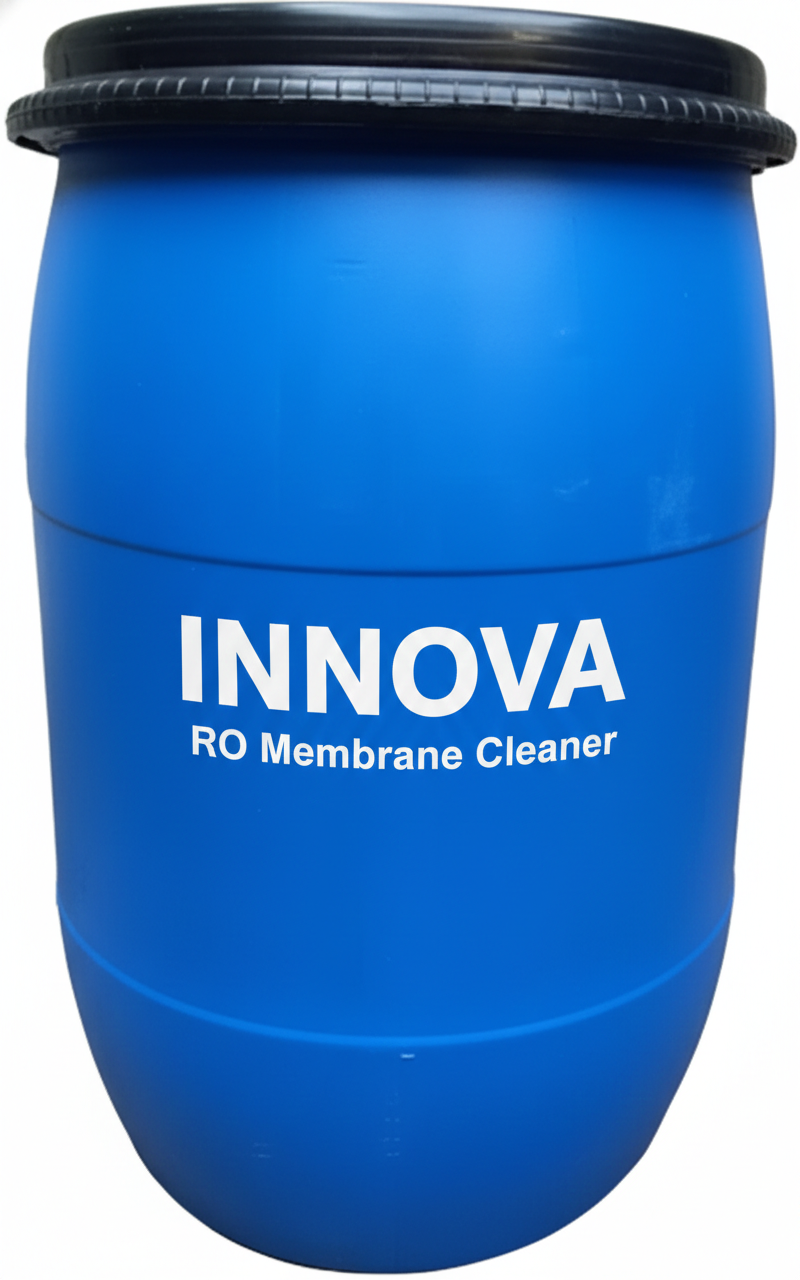
RO Membrane Cleaner Chemicals in Sweden (CIP Solutions)
Fouling in a Swedish RO system rarely fits into a single category. The water that feeds these systems comes from lake and river sources with high natural organic matter, from shield groundwater with dissolved iron and manganese, from Baltic brackish feedwater with seasonal algal blooms, and from industrial process streams with mixed mineral and organic content. When these foulants deposit on a membrane, they rarely stay as separate layers. Humic substances bind with iron oxides. Carbonate scale traps organic matter within its crystal structure. Biofilm grows on top of whatever else is already there. Removing this mixed deposit requires a cleaning program designed for layered fouling — not a single generic chemistry.
Innova Corporate (India) is a premier manufacturer and exporter of high-performance RO membrane cleaners for Sweden. Our cleaning chemicals are formulated using premium-grade constituents and advanced methodologies to ensure thorough removal of scales and foulants, extending the life of your Reverse Osmosis system. The comprehensive range effectively targets silica scales, biological slimes, oils, iron and manganese fouling, humic substances and complex organic compounds — restoring membrane flux and salt rejection efficiency for Swedish industrial units.
Our specialized range for Sweden includes:
- Low pH Membrane Cleaner
- High pH Membrane Cleaner
- Iron Fouled Membrane Cleaner
- Manganese Fouled Membrane Cleaner
- Humic & Organic Fouling Cleaner
- Silica Fouled Membrane Cleaner
- RO Membrane Preservative
- RO Dechlorination Chemicals
Cold-Water CIP Protocol for Swedish RO Systems:
- Step 1 — Diagnose the Deposit: Review normalized permeate flow, salt passage and differential pressure trends. Identify whether the dominant foulant is humic organic, mineral, iron/manganese, biological or a layered combination. Mixed fouling requires a two-step program.
- Step 2 — Alkaline First (Swedish Surface Water Standard): For lake and river sources with high humic content, alkaline cleaning comes first. It dissolves the organic layer, exposes the mineral deposit underneath, and breaks the organic-iron complex that binds iron fouling to the membrane.
- Step 3 — Acidic Second: Follow with low pH cleaner to dissolve carbonate scale, iron oxide deposits and manganese dioxide. Monitor solution pH and colour during circulation — when they stabilise, the reaction is complete.
- Step 4 — Sequence Reversal for Shield Groundwater: If the feedwater is primarily shield groundwater with carbonate and iron fouling and low organic content, consider acidic cleaning first, followed by alkaline cleaning to remove any residual organic matter.
- Step 5 — Temperature Optimization: Optimal cleaning temperature is 25°C to 35°C. In Swedish cold-water conditions, heating the cleaning solution is strongly recommended. Where heating is impractical, extend contact time and use our cold-water-optimised formulations.
- Step 6 — Verify Recovery: Compare post-CIP normalized parameters against baseline. Full recovery restores permeate flow to within 5–10 percent of baseline and returns differential pressure to its original value. If recovery is partial, fouling may be irreversible — autopsy is recommended.
CIP Hydrodynamics for Nordic Operating Conditions:
- Temperature: 25°C to 35°C is optimal. In Sweden, feedwater often enters the CIP skid at 5°C to 10°C. Heating to at least 25°C makes a significant difference in cleaning effectiveness.
- Circulation Velocity: 8 to 12 feet per second through the membrane element ensures turbulent flow and mechanical scouring action in addition to chemical dissolution.
- Soak Time: 30 to 120 minutes depending on fouling severity. In cold water, extend soak time by 30 to 50 percent compared to temperate conditions.
- Solution Monitoring: Check pH, colour and turbidity of the cleaning solution during circulation. Stabilisation indicates the reaction is complete.
- Flush Volume: Flush with at least two to three times the cleaning loop volume to ensure complete removal of residual chemical before returning to service.
- Freeze Protection: For northern Sweden and island installations, protect cleaning chemicals from freezing during transport and storage. If frozen, thaw gradually and stir before use.
Key Features: Our cleaners are characterized by low foaming, precise pH values, and biodegradable properties. They provide excellent system clean-up for Sweden's industrial water treatment plants, boilers, food processing units, and dairies. Regular use prevents irreversible membrane damage and reduces operational costs by extending cleaning intervals and membrane service life. All products are REACH and CLP compliant, with documentation aligned to Livsmedelsverket requirements for potable water applications.
Signs Your Swedish RO System Needs CIP:
Frequently Asked Questions — RO Membrane Cleaner in Sweden
1. Why does Sweden's humic-rich water require a different CIP approach?
Sweden's lake and river water carries unusually high natural organic matter (NOM) dominated by humic and fulvic acids. These large, complex molecules adsorb onto membrane surfaces through a mechanism that is fundamentally different from mineral scaling. Humic fouling does not crystallise — it forms a gel-like layer that is resistant to standard acid cleaning. Alkaline cleaning is required to solubilise the humic fraction, breaking it into smaller fragments that can be flushed away. Swedish plants therefore almost always need a two-step CIP program: alkaline cleaning first to remove the organic layer, then acid cleaning to remove any mineral scale underneath. The sequence matters, and our formulations are designed specifically for this Swedish humic-fouling challenge.
2. How does cold Swedish feedwater affect CIP performance?
Cold water slows chemical reaction kinetics, so cleaning solutions need longer contact time or higher temperatures to achieve the same effect as in warm-water systems. In Sweden, CIP is often performed with feedwater at 5°C to 10°C, and some plants heat the cleaning solution to 25°C to 35°C for better results. Our cleaners are formulated to remain effective at low temperatures, with detergent and dispersant chemistry that stays active even in cold conditions. We provide specific guidance on contact time and temperature optimisation for each Swedish client's system and season.
3. What is the correct CIP sequence for Swedish RO systems with mixed fouling?
For Swedish surface water with mixed humic and mineral fouling, the standard sequence is alkaline cleaning first, followed by acid cleaning. Alkaline cleaning removes the organic layer — humic substances, biofilm, and any algal debris — exposing the mineral deposit underneath. Acid cleaning then dissolves carbonate scale, iron oxide deposits, and manganese dioxide. If the system runs on hard shield groundwater with primarily carbonate and iron fouling, the sequence may be reversed to acid first, alkaline second. We help clients determine the correct sequence based on water analysis and autopsy findings.
4. How do I remove iron and manganese fouling from Swedish groundwater sources?
Swedish shield groundwater commonly contains dissolved iron and manganese, which oxidise inside the RO system and deposit as coloured oxides on the membrane surface. These deposits are usually bound with organic matter, so a single cleaning chemistry rarely removes them completely. Our recommended approach is alkaline cleaning first to break the organic-iron complex, followed by acidic cleaning with a chelating-enhanced formulation that dissolves the metal oxides. For heavy manganese fouling, which is harder to dissolve than iron, we may recommend a specialised formulation and multiple cleaning cycles.
5. What is membrane autopsy and when is it recommended in Sweden?
Membrane autopsy is a destructive analysis of a fouled element to identify the composition of deposits, check for membrane integrity damage, and confirm whether fouling is reversible. In Swedish plants, autopsy is recommended when performance does not recover after correctly executed CIP, when fouling recurs rapidly after cleaning, or when the specific nature of fouling is unclear — for example, distinguishing between humic fouling, biofilm and mineral scale. Autopsy results inform the optimal cleaning program and can prevent repeated ineffective cleaning cycles. We support Swedish clients through the autopsy process and interpret the results.
6. How do I verify that CIP has been effective in my Swedish RO system?
Compare normalized parameters before and after cleaning: permeate flow, salt passage and differential pressure, all corrected for temperature. Effective cleaning typically recovers permeate flow to within 5 to 10 percent of baseline and brings differential pressure back to original values. If recovery is partial, a second cleaning cycle may be needed, or the fouling may be irreversible. Beyond immediate post-CIP verification, monitor the rate at which performance declines after cleaning — if the system re-fouls within weeks, the pretreatment or antiscalant program may need review.
7. What temperature should the CIP solution be for Swedish conditions?
The optimal cleaning temperature is 25°C to 35°C for most membrane types. In Sweden, where feedwater may be as cold as 2°C to 8°C, heating the cleaning solution is strongly recommended for effective cleaning. Even reaching 25°C makes a significant difference in removal efficiency and can reduce the number of CIP cycles needed. For plants where heating is impractical — for example, remote installations or large systems with high volume — our cold-water formulations remain active at 5°C to 10°C, with extended contact time to compensate for slower kinetics.
8. Are your membrane cleaners safe for Swedish potable water systems?
Yes. Our cleaners are formulated for use with polyamide thin-film composite membranes used in potable water production. After CIP, a thorough permeate flush is performed before returning the system to service, ensuring no cleaning chemical residue remains in the permeate. We provide documentation aligned with Livsmedelsverket requirements for potable water applications, including residual verification procedures and maximum permissible concentrations. All cleaners are REACH and CLP compliant.
9. How should CIP chemicals be stored and handled in Sweden's climate?
Store acidic and alkaline cleaners separately in original sealed containers between 5°C and 30°C, away from direct sunlight and incompatible chemicals. For northern Sweden, protect from freezing during transport and storage — most cleaners will not tolerate repeated freeze-thaw cycles without quality impact. If the product does freeze, thaw gradually at room temperature and stir before use. Never mix acidic and alkaline cleaners directly; they must be used in sequence with intermediate flushing. Wear appropriate PPE during handling, and refer to the MSDS for complete safety information.
10. How do you ship CIP chemicals from India to Sweden?
We ship from Indian ports to Gothenburg, Malmö, Stockholm, Helsingborg, Trelleborg and other major Swedish ports. All shipments include commercial invoice, packing list, certificate of origin, MSDS compliant with REACH and CLP requirements, and any certificates required by Swedish Customs and the EU. Acidic and alkaline cleaners are classified as corrosive materials and are packed in UN-approved containers with proper classification, labelling and dangerous goods documentation. We work with freight forwarders experienced in EU import procedures and can support clients through customs clearance and REACH registration requirements where applicable.
For customized CIP (Clean-In-Place) protocols and to select the right cleaner for your specific water analysis, contact our technical service engineers in Sweden.