- 2B / BW Shalimar Bagh, Opp. BQ Market, Near DLF Mall New Delhi - 110088, India.
- :+91-9312-871-070

Manufacturers, Exporters, Suppliers of RO Disinfectant Chemicals
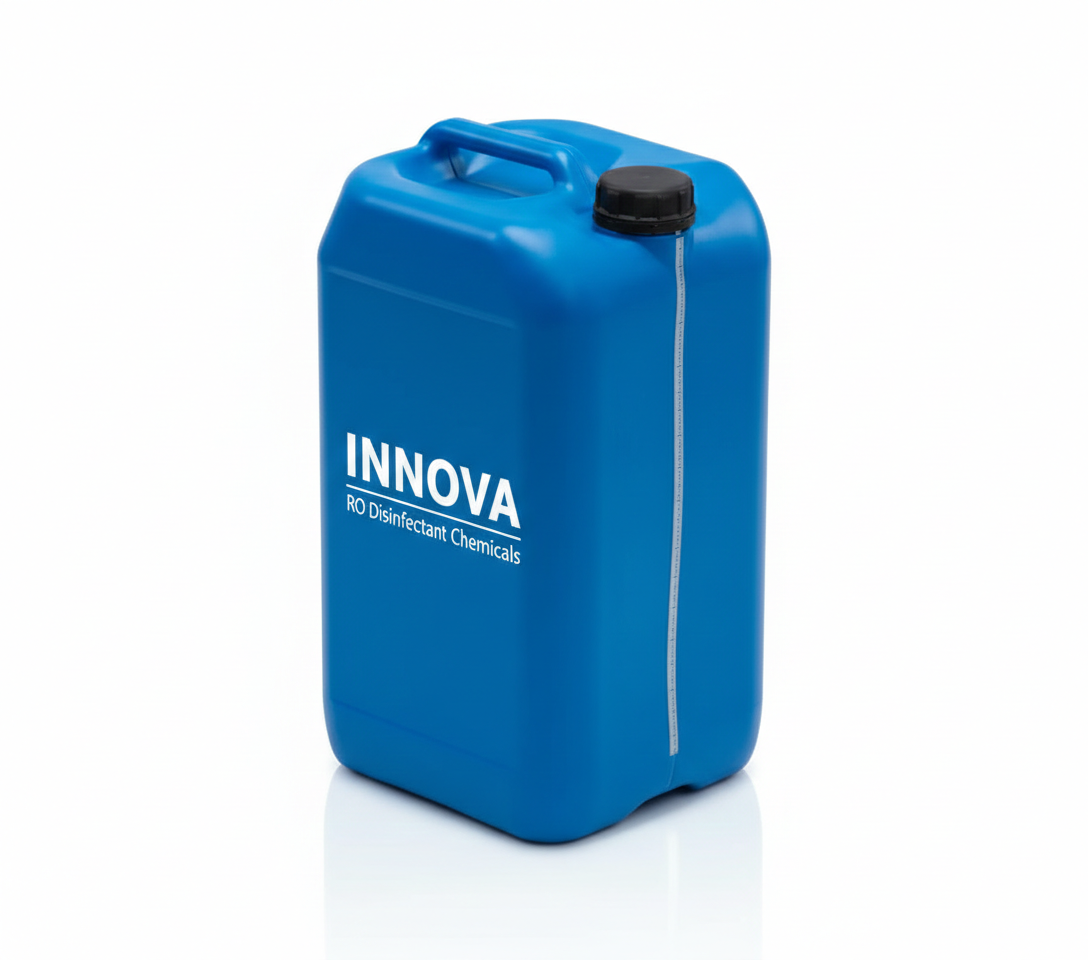
RO Disinfectant Chemicals in Sweden (Non-Oxidizing Microbiocide)
Innova Corporate (India) is a premier manufacturer and exporter of high-efficacy RO disinfectant chemicals for Sweden. Biological fouling and biofilm growth can severely restrict membrane flow and compromise water quality in ways that standard cleaning cannot address. Our specialised non-oxidizing microbiocide is engineered to eliminate a broad spectrum of microorganisms — bacteria, fungi, algae and Legionella — without damaging sensitive polyamide membrane structures. The formulation is compliant with the EU Biocidal Products Regulation (BPR), which Sweden enforces strictly as a full member state.
Our RO disinfectant in Sweden is a safe and powerful solution for the disinfection of Reverse Osmosis systems, including those used for potable water production. It effectively targets the cold-adapted (psychrophilic) microorganisms that dominate Swedish feedwater, where temperatures often sit between 2°C and 12°C throughout the year. These organisms are harder to kill with conventional biocides because their cell membranes are adapted to cold conditions. Our formulation remains effective across the full Swedish temperature range, ensuring that your membrane system remains free from biological sliming and maintains peak performance.
Because Sweden's municipal and food processing plants operate under strict hygiene requirements, our disinfectant is designed with the full regulatory framework in mind. Documentation aligned with Livsmedelsverket (Swedish Food Agency) requirements for potable water applications and Naturvårdsverket discharge guidelines is provided with every shipment. The active substances used are BPR-approved — typically DBNPA or isothiazolinone — and the authorised use patterns are documented so that Swedish operators can demonstrate compliance during regulatory inspections.
Key Features & Strategic Benefits for Sweden:
- BPR-Compliant Formulation: Active substances and use patterns align with the EU Biocidal Products Regulation, ensuring legal use and clear compliance documentation for Swedish operators.
- Broad-Spectrum Efficacy: Highly effective against bacteria, fungi, algae, biofilm-forming organisms and Legionella pneumophila across cold-water Nordic conditions.
- Cold-Water Performance: Tested at 2°C to confirm efficacy against psychrophilic microorganisms that dominate Swedish feedwater throughout the year.
- Potable Water Safe: Certified for use in RO systems producing drinking water when dosed per BPR-authorised guidelines, with Livsmedelsverket-aligned documentation.
- Non-Oxidizing Formula: Unlike chlorine or peracetic acid, it does not oxidise or degrade Polyamide or TFC membranes — protecting the membrane investment.
- No Chlorinated By-Products: Avoids the formation of trihalomethanes and other halogenated compounds, supporting Naturvårdsverket discharge compliance.
- Eco-Friendly & Biodegradable: Environmentally responsible formulation that breaks down safely after use, supporting Sweden's strict environmental standards and circular economy goals.
- Total System Compatibility: Fully compatible with all RO membrane components, housings, high-pressure pumps and downstream EDI, UV or ultrafiltration stages.
- Extensive Shelf Life: 24 months under recommended storage conditions, with cold-weather freeze protection guidance for northern Sweden.
Application & Dosage for Sweden Plants:
Dosage depends on the severity of biological fouling and the temperature of the water. In cold Swedish conditions, contact time may need to be extended because reaction kinetics are slower than in warm climates. We recommend two primary methods for Sweden facilities:
- Shock Dosing (Immediate Disinfection): Use a concentration of 5–10% v/v for rapid system sterilisation during shutdowns, with a soak time of 60 to 90 minutes in cold water (compared to 30 minutes in temperate climates).
- Continuous Dosing (Preventative): Maintain a concentration of 1–2.5 ppm on the feed water for round-the-clock microbial control, with slight upward adjustment for Norrland operations where water stays below 8°C year-round.
Recommended Membrane Cleaning Protocol for Sweden:
- Disinfect the system with Innova RO Disinfectant using shock dosing for cold-water contact time.
- Flush thoroughly with permeate water until residual biocide is removed.
- Circulate a High pH Membrane Cleaner solution for 30 minutes, then soak for 1–2 hours to remove organic residue released by disinfection.
- Final flush with permeate water before returning the Sweden plant to normal service, verifying residual biocide concentration is below Livsmedelsverket limits for potable water systems.
*Note: In multi-pass systems, disinfect and clean each pass individually for the best results. Replace cleaning solutions if they become excessively turbid, especially after heavy organic loading.*
Strategic Benefits Delivered to Swedish Plants:
Safety & Handling: Proper PPE (splash goggles, lab coats, gloves and vapour respirators) must be worn during handling. Store in original containers in a cool, dry place at your Sweden site, away from direct heat or sunlight. For northern Sweden, protect from freezing during transport and storage. If the product freezes, thaw gradually at room temperature and stir before use — performance is unaffected. Complete safety documentation aligned with Arbetsmiljöverket requirements is available in Swedish on request.
Frequently Asked Questions — RO Disinfectant Chemicals in Sweden
1. What is BPR and why does it matter for RO disinfectants sold into Sweden?
BPR stands for Biocidal Products Regulation (EU Regulation 528/2012). It governs the authorisation, classification, labelling and use of all biocide products placed on the EU market, including those used for water treatment and membrane disinfection. Sweden, as a full EU member state, enforces BPR strictly. Any biocide sold into Sweden must be either authorised under BPR or covered by an approved active substance. Our RO disinfectants are formulated using BPR-approved active substances — typically DBNPA or isothiazolinone — and we provide the compliance documentation required for import and use in Sweden.
2. Why is cold-water microbiology different in Swedish RO systems?
Swedish feedwater is cold throughout much of the year, often between 2°C and 8°C in Norrland and 6°C to 12°C in southern regions. Cold water slows microbial growth rates but does not stop them. Instead, it selects for psychrophilic (cold-adapted) microorganisms that grow optimally at low temperatures. These organisms can be harder to kill with standard biocides because their cell membranes have adapted to cold conditions. Our disinfectant is formulated to be effective against both mesophilic and psychrophilic organisms across the full Swedish temperature range. We test at 2°C to confirm performance.
3. How does the BPR affect biocide dosing documentation for Swedish plants?
BPR requires that biocide products be used only for the applications and at the doses specified in their authorisation. This means Swedish plants must document their biocide use according to the product's registered use pattern. Our documentation includes the authorised dose ranges, application methods and target organisms for each biocide we supply. This simplifies the compliance process for Swedish operators who must demonstrate BPR-appropriate use during Naturvårdsverket discharge reporting and Livsmedelsverket inspections.
4. Can RO disinfectants control Legionella in Swedish water systems?
Yes, when applied correctly. Legionella is a concern in warm water systems, including some industrial water treatment applications where temperatures can promote growth. In Sweden, Legionella prevention is particularly important in buildings with complex water systems and in industrial cooling circuits. Our non-oxidizing biocides have demonstrated efficacy against Legionella pneumophila in independent testing, and are approved under BPR for use against this organism. Application requires specific dosing and contact time, which we document for each client.
5. What is the difference between oxidizing and non-oxidizing biocides for Swedish RO systems?
Oxidizing biocides — chlorine, chlorine dioxide, ozone, peracetic acid — kill microorganisms by chemical oxidation. They are effective but aggressive toward polyamide RO membranes, which are sensitive to oxidants. Non-oxidizing biocides — DBNPA, isothiazolinone, glutaraldehyde, quaternary ammonium compounds — kill through mechanisms other than oxidation and are membrane-safe. In Sweden, where polyamide membranes dominate, non-oxidizing biocides are the standard choice for RO applications. They also avoid the formation of chlorinated disinfection by-products, which is relevant for Swedish discharge compliance and for potable water applications.
6. How do I determine the correct dose of RO disinfectant for my Swedish system?
Dose depends on the microbial load, the type of organism present, the contact time available and the temperature of the water. For routine continuous dosing, concentrations typically range from 1 to 2.5 ppm. For CIP shock disinfection, 5 to 10 percent v/v for 60 to 90 minutes is common in cold Swedish water. In cold water, contact time may need to be extended because reaction kinetics are slower. We provide free dose calculation based on your water analysis, system configuration and microbial monitoring data.
7. Is RO disinfectant safe for potable water applications in Sweden?
Yes, when used according to the authorised application pattern. Our BPR-compliant biocides are authorised for use in potable water systems under specified conditions. After treatment, a flush step removes residual biocide before the water enters the distribution system. We provide documentation aligned with Livsmedelsverket requirements and EU drinking water directive specifications, including maximum residual concentrations and flush verification procedures.
8. How does Swedish cold-water operation affect biocide contact time?
Cold water slows the reaction between biocide and microbial cells, so effective kill requires longer contact time than in warm water. At 20°C, a 30-minute contact time may be sufficient for full kill of most organisms. At 2°C, the same level of kill may require 60 to 90 minutes. We recommend extending CIP soak times in cold Swedish systems to ensure effective disinfection. For continuous dosing, slight increases in dose or dosing frequency compensate for the slower kinetics.
9. Does your RO disinfectant leave residues that affect permeate quality?
Non-oxidizing biocides used at recommended doses do not affect permeate quality. The biocide is dosed on the feed side and either reacts with microorganisms in the feed stream or passes into the concentrate stream. Any residual that reaches the permeate is typically below detection limits at normal doses. For potable water applications, we provide documentation on maximum permissible residual concentrations and flush verification protocols to ensure compliance with Swedish drinking water standards.
10. What documentation is provided with RO disinfectant shipments to Sweden?
Every shipment to Sweden includes Material Safety Data Sheet (MSDS) compliant with REACH and CLP requirements, Technical Data Sheet (TDS), Certificate of Analysis (COA), BPR compliance statement with authorised use pattern, and dosing guidelines for cold-water applications. For potable water applications, we provide Livsmedelsverket-aligned documentation including residual limits and flush verification procedures. For discharge compliance, we supply information suitable for Naturvårdsverket reporting. Swedish-language summaries are available on request.