- 2B / BW Shalimar Bagh, Opp. BQ Market, Near DLF Mall New Delhi - 110088, India.
- :+91-9312-871-070

Manufacturers, Exporters, Suppliers of High Silica RO Antiscalant
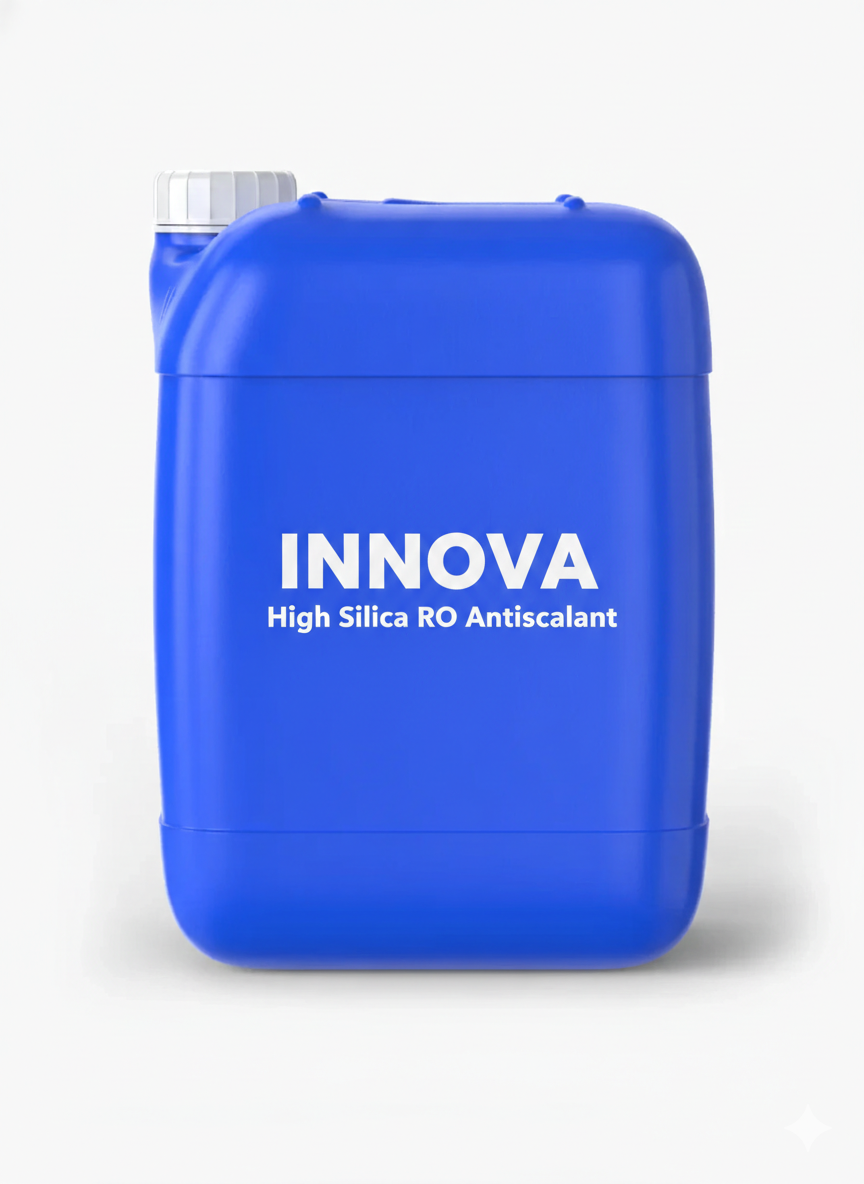
High Silica RO Antiscalant for Extreme Silica Loads in Uttar Pradesh
Innova Corporate (India) produces a high-load High Silica RO Antiscalant for Uttar Pradesh plants that run on genuinely difficult water. Certain pockets of the state — the deeper aquifers around Noida and Greater Noida, the mixed industrial and municipal supply in Kanpur and Ghaziabad, and the semi-arid belts near Agra and Mathura — consistently show dissolved silica in the feed that pushes concentrate-side silica past 250 ppm. At that point ordinary antiscalants lose control, silica starts to polymerise, and membranes begin to foul in ways CIP chemicals struggle to reverse. This grade is built for exactly that operating envelope.
The chemistry here works on two fronts at once. It holds silica in a dispersed, non-reactive form throughout the concentrate path, and it simultaneously sequesters dissolved iron and manganese so they cannot oxidise into the reddish deposits that are common across Uttar Pradesh tube-well-fed RO plants. The result is a membrane surface that stays clean at higher recovery, with stable differential pressure and normalised permeate flow. It performs reliably at LSI up to +2.5, reject iron up to 1.5 ppm, and reject silica up to 325 ppm (mg/l) — a range that covers most heavy-duty Uttar Pradesh industrial installations.
Operational Advantages for Uttar Pradesh Plants:
- Control at High Silica Loads: Maintains silica dispersion even when concentrate-side silica approaches 325 ppm, a level where standard products fail.
- Iron and Manganese Sequestration: Handles the dissolved iron typical of Uttar Pradesh groundwater before it can oxidise and stain membranes.
- Supports Aggressive Recovery: Lets Uttar Pradesh operators push recovery upward on constrained water without risking silicate scaling.
- Tolerant of Real-World Feed: Functions across wide pH, TDS and SDI ranges, so it suits plants with basic pretreatment as well as fully automated systems.
- Economical at Low Dosage: Effective across the 2–20 ppm band, which keeps chemical cost per cubic metre of permeate low.
- Membrane-Safe and Organic: Biodegradable liquid formulation compatible with polyamide, TFC and NF membranes used across Uttar Pradesh.
Application & Dosage: Inject the antiscalant continuously into the RO feed line downstream of pretreatment and upstream of the cartridge filter. For Uttar Pradesh installations, the working dose usually falls between 2 ppm and 20 ppm, set by feed calcium hardness, alkalinity, iron and silica. Where feed iron sits in the 0.5–1.0 ppm range, a dose of 5–7 ppm is typically required for full stabilisation, and silica-dominant feeds may need the upper end of the range. We recommend a feed water analysis before locking in a dosing schedule.
Storage & Stability: Keep drums sealed and stored in a cool, dry, shaded area at your Uttar Pradesh site, away from direct sun and any heat source, to preserve full chemical activity. Detailed application guidance, safety information and handling precautions are covered in the Technical Data Sheet (TDS) and Material Safety Data Sheet (MSDS).