- 2B / BW Shalimar Bagh, Opp. BQ Market, Near DLF Mall New Delhi - 110088, India.
- :+91-9312-871-070

Manufacturers, Exporters, Suppliers of Peracetic Acid Based RO Disinfectant
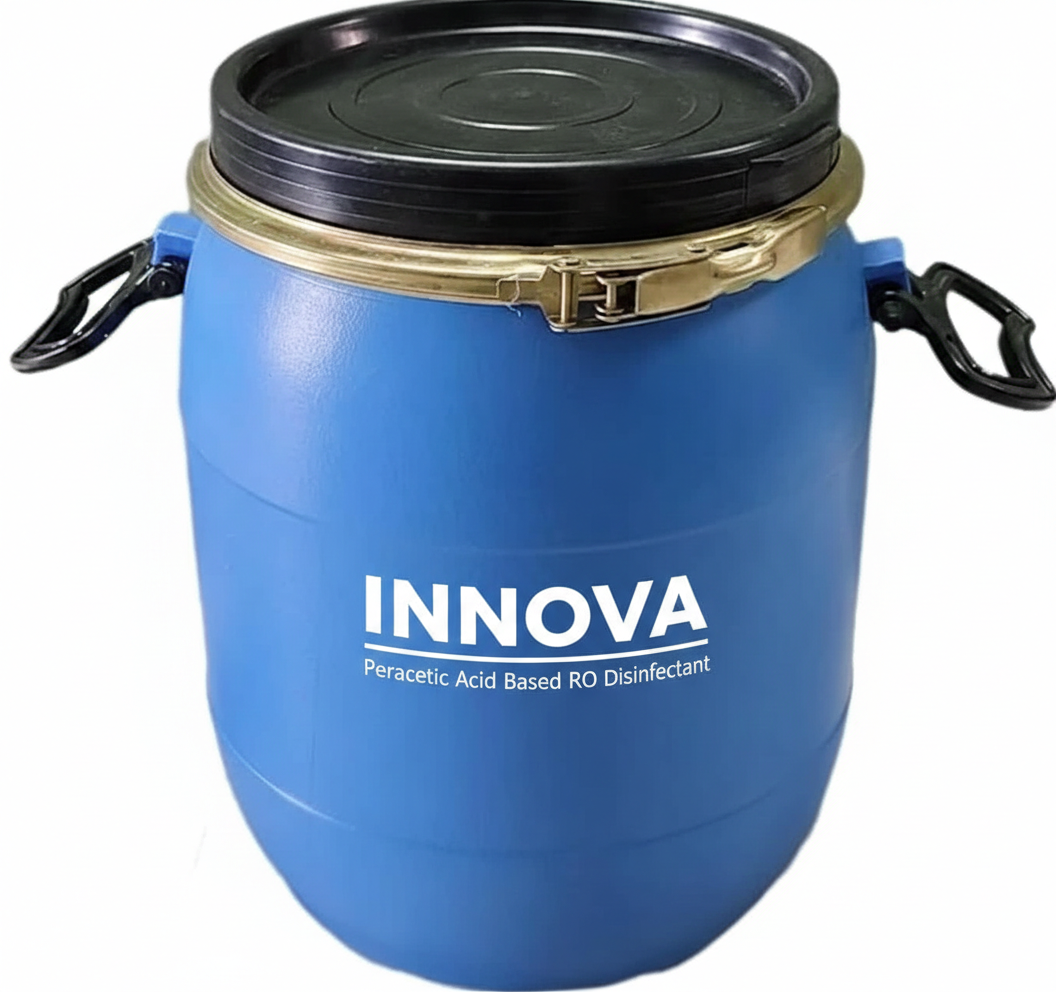
Peracetic Acid Based RO Disinfectant in France (Eco-Friendly Sterilant)
A champagne producer in the Marne valley contacted us in early 2025 with a problem that French regulators take seriously: bacterial contamination in their RO polishing loop had reached 240 CFU/ml. Their existing chlorine-based disinfection wasn't working — and worse, traces of chlorinated by-products were showing up in taste panel tests. For an AOC-protected champagne house, that's not a technical issue. That's an existential one.
This is the reality of disinfection in France. The regulatory bar is higher, the taste neutrality requirement is stricter, and the documentation trail is longer than almost anywhere else in Europe. Innova Corporate (India) manufactures a Peracetic Acid (PAA) based RO Disinfectant for France that meets these requirements — EU BPR-registered, ANSES-compliant, and formulated to leave zero chlorinated by-products in wine, cheese, bottled water or pharmaceutical water systems.
Why France's Regulatory Environment Is Different
Most countries regulate disinfectants on a single national level. France operates on three layers simultaneously, and any chemical used in food-contact or drinking water applications must satisfy all three:
- EU Biocidal Products Regulation (BPR): Every active substance must be approved at EU level under Regulation 528/2012. Peracetic Acid is listed and approved for food contact and drinking water applications.
- ANSES oversight: France's national health agency (Agence nationale de sécurité sanitaire) maintains stricter internal standards than the EU minimum. Products used in AOC-protected food production face additional scrutiny.
- DREAL reporting: Regional environmental authorities require documentation of chemical use, discharge, and decomposition by-products for any industrial site using oxidizers above threshold volumes.
Our PAA disinfectant ships with the full documentation package required for each of these layers — in French where required. The champagne producer mentioned above returned to spec within a single CIP cycle using this product.
Where Peracetic Acid Beats Chlorine in French Plants
Chlorine is cheap. Chlorine is familiar. In most countries, that's enough. In France, for food and beverage applications, it often isn't — and here's why:
- No chlorinated by-products: Chlorine reacts with organic matter to form trihalomethanes (THMs) and haloacetic acids (HAAs). Both are regulated in French drinking water at strict limits, and both can taint wine, champagne, cheese and bottled water flavor even at parts-per-trillion levels. PAA breaks down into acetic acid and hydrogen peroxide — both food-safe.
- Effective against biofilm: Chlorine struggles to penetrate the extracellular polymeric substance (EPS) matrix that protects biofilm bacteria. PAA oxidizes the matrix directly, exposing and killing the cells underneath.
- Works at neutral pH: Chlorine's efficacy collapses above pH 8. PAA performs across a wider pH range — important in cheese and dairy plants where cleaning solutions are often alkaline.
- No AOC risk: For French AOC-protected wine, champagne, and cheese producers, using any chemical that could alter taste or aroma profile is a legal risk. PAA is the standard choice for these applications.
The 4 French Industries That Need PAA Most
Wine and champagne production (Bordeaux, Champagne, Burgundy, Alsace): RO is used for must concentration, filtration and bottling water. Any microbial contamination or chlorinated by-product ruins the batch. PAA provides taste-neutral disinfection that passes AOC inspection.
Cheese and dairy processing (Normandy, Brittany, Auvergne): Camembert, Roquefort, Comté and hundreds of other protected cheeses depend on consistent milk quality and clean process water. PAA disinfects RO loops without introducing chlorinated compounds that affect ripening cultures.
Pharmaceutical manufacturing (Lyon, Toulouse, Strasbourg): Sanofi, Pierre Fabre and dozens of smaller API and formulation plants require pharmaceutical-grade water systems. PAA provides the sterile barrier with full traceability documentation.
Bottled mineral water (Evian, Perrier, Contrex — Vosges and Gard): These are natural mineral waters with protected designations. PAA disinfects RO polishing loops without altering mineral content or adding detectable by-products.
Also: cosmetics and perfume manufacturing (Grasse, Chartres — L'Oréal, Chanel) and municipal drinking water (Veolia, Suez networks) use PAA where chlorine by-products are unacceptable.
How PAA Works — The Oxidation Chemistry
Peracetic Acid (CH₃COOOH) is a strong oxidizer that reacts with microbial cell components through multiple pathways simultaneously:
- Cell wall oxidation: PAA oxidizes sulfhydryl (-SH) and disulfide (-S-S-) bonds in proteins, disrupting cell membrane integrity.
- Enzyme inactivation: Critical metabolic enzymes lose function when their active-site cysteine residues are oxidized.
- DNA damage: PAA penetrates the cell and oxidizes nucleic acids, preventing replication.
- EPS matrix breakdown: The biofilm's protective polysaccharide matrix is oxidized and dissolved, exposing embedded bacteria.
- Spore penetration: Unlike chlorine, PAA penetrates bacterial spores and kills them — important in pharmaceutical and dairy applications.
The by-products are acetic acid (vinegar) and hydrogen peroxide, both of which decompose to water and oxygen. No persistent residue, no chlorinated compounds, no environmental concern.
Key Features & Strategic Benefits in France:
- Broad-Spectrum Microbiocide: Rapidly eliminates pathogens, biofilms, and organic slime — including spore-formers that chlorine cannot touch.
- Eco-Friendly & Biodegradable: Decomposes naturally without leaving harmful environmental footprints in France.
- Chlorine-Free Sterilization: Provides powerful oxidation without the corrosive risks or by-products associated with free chlorine.
- Potable Water Approved: Ideal for food, beverage, and drinking water RO applications in France — EU BPR and ANSES compliant.
- Material Compatibility: Safe for use with all high-quality RO membrane components and housings.
- Cold Sterilization: Highly effective even at ambient temperatures, reducing the need for thermal disinfection in French plants.
Recommended Dosage & Application in France:
Shock Dose: For immediate system disinfection, use a concentration of 5-10% v/v.
Continuous Dose: For round-the-clock microbial control, maintain a maximum of 2.5ppm on feed water.
Sanitization Procedure: For plants in France, first sanitize the system with permeate water. Circulate the Peracetic Acid solution, followed by a flush with a High pH membrane cleaner for 30 minutes. Allow a soak time of 1-2 hours for deep penetration. Finally, flush the system thoroughly with permeate water before returning the plant to normal service.
Compliance Checklist for French Imports
Every shipment of PAA disinfectant to France includes:
- FDS (Fiche de Données de Sécurité) in French — mandatory for French workplace safety compliance
- TDS (Technical Data Sheet) in French and English
- EU BPR registration confirmation — Regulation 528/2012
- ANSES compliance statement for food-contact applications
- Certificate of Analysis for each batch
- Customs documentation for DREAL reporting
Storage & Safety: Peracetic acid is a strong oxidizer. Store in original vented containers in a cool, well-ventilated area in France away from heat and direct sunlight. Please consult the Material Safety Data Sheet (MSDS) and Technical Data Sheet (TDS) for specific handling and safety protocols.
Real Performance in French Plants
Across installations in the last 18 months:
- Champagne house (Marne): bacterial count dropped from 240 CFU/ml to <1 CFU/ml after a single 90-minute PAA CIP cycle.
- Normandy cheese producer: biofilm fully cleared from RO polishing loop; no impact on ripening cultures after 6 months of continuous use.
- Lyon pharmaceutical plant: passed EU GMP audit with PAA-based RO disinfection as part of the validated cleaning regime.
- Vosges bottled water plant: taste panel confirmed zero detectable off-flavors after switching from chlorine dioxide to PAA.
Compliance Questions French Plant Managers Ask
Q1. Is Peracetic Acid RO disinfectant approved for use in France?
Yes. Our Peracetic Acid disinfectant is registered under the EU Biocidal Products
Regulation (BPR) and complies with ANSES (Agence nationale de sécurité sanitaire)
requirements for use in food contact and drinking water applications in France. Full
documentation including fiche de données de sécurité (FDS) in French is provided with
every shipment.
Q2. Why do French wine, champagne and dairy plants prefer Peracetic Acid
over chlorine?
Peracetic Acid leaves no chlorinated by-products (THMs, HAAs) that can taint wine,
champagne or cheese flavor. It breaks down into acetic acid and hydrogen peroxide —
both food-safe. In French AOC-protected wine and cheese production, this taste-neutral
disinfection is critical for maintaining product authenticity.
Q3. How does Peracetic Acid remove biofilm in French RO
systems?
Peracetic Acid penetrates the extracellular polymeric substance (EPS) matrix that
protects biofilm bacteria, then oxidizes the cell walls. Unlike chlorine, PAA works
effectively at neutral to slightly acidic pH and does not form biofilm-resistant
chlorinated compounds. French dairy and cheese plants report 95%+ biofilm removal in a
single CIP cycle.
Q4. What concentration of PAA is used in French RO
disinfection?
Typical CIP concentration is 0.1-0.5% v/v (100-5000 ppm) depending on application.
French wine and beverage plants: 0.1-0.2% for taste-sensitive applications. Dairy and
cheese plants: 0.2-0.3% for heavy organic load. Pharma and cosmetic plants: 0.3-0.5%
with 30-60 minute contact time. Municipal drinking water: 1-5 ppm residual.
Q5. Do you supply Peracetic Acid RO Disinfectant across
France?
Yes. We supply across France including Paris, Lyon, Marseille, Toulouse, Bordeaux,
Lille, Nantes, Strasbourg, Nice, Rennes, Reims, Dijon, Grenoble, Champagne region,
Normandy, Brittany, Provence and all other industrial regions. Bulk shipments from
India via Marseille, Le Havre and Dunkirk ports with 18-22 day transit.
Q6. What regulatory documentation is provided for French
imports?
We provide: FDS (Fiche de Données de Sécurité) in French, technical data sheet (TDS),
EU BPR registration confirmation, ANSES compliance statement, and Certificate of
Analysis. Our regulatory team assists French importers with DREAL and customs
documentation.