- 2B / BW Shalimar Bagh, Opp. BQ Market, Near DLF Mall New Delhi - 110088, India.
- :+91-9312-871-070

Manufacturers, Exporters, Suppliers of RO Antiscalant Low pH
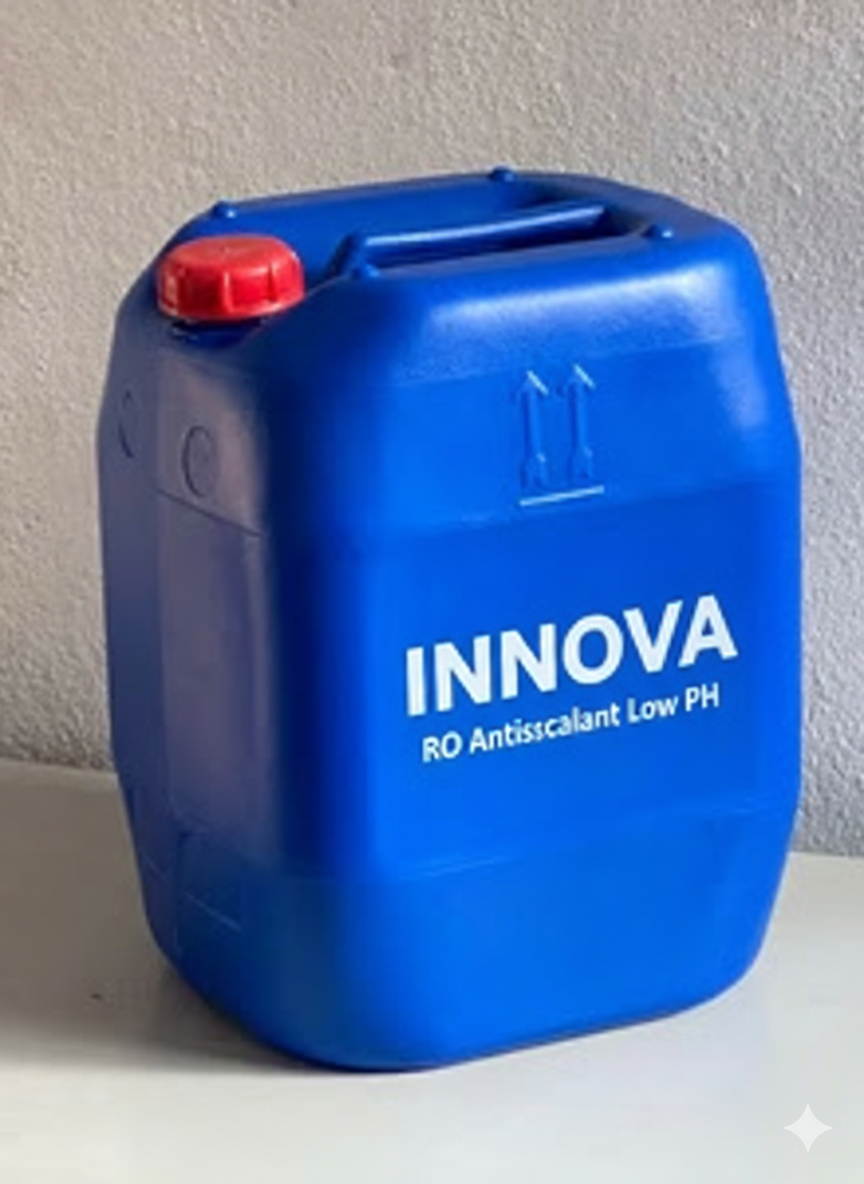
RO Antiscalant Low pH in France (Broad Spectrum Formula)
A municipal plant operator in Seine-et-Marne sent us a membrane autopsy last spring that told a story 100 million years in the making. The last-stage elements were coated with a hard white deposit — classic calcium carbonate scale. The feed water came from a limestone aquifer that had been filtering through sedimentary rock since the Cretaceous period. LSI at the feed was +1.9. At the reject end, where concentration factors peak, LSI was +3.2. The plant was designed for +2.0. No antiscalant on the market at that time could handle the +3.2 reality. The membranes were scaling within weeks of each CIP.
This is the geochemical challenge of the Paris Basin, Champagne, Burgundy, Picardy and the Loire Valley. Innova Corporate (India) manufactures Low pH RO Antiscalants for France engineered specifically for limestone-fed water with LSI up to +2.8. Our broad-spectrum acidic formulation handles the calcium carbonate, sulfate and metal oxide deposition that defines French sedimentary geology — from the craie chalk of Champagne to the tuffeau limestone of Touraine.
Paris Basin Limestone — 100 Million Years in the Making
The Paris Basin is one of the world's classic sedimentary formations. Between 100 and 200 million years ago, shallow seas deposited layer upon layer of calcium carbonate shells and skeletons. Today, that limestone is 200-3,000 meters thick beneath Paris, Reims, Troyes and Orléans. Water percolating through it dissolves calcium carbonate continuously:
- Calcium concentration: 120-180 mg/L in most Paris Basin groundwater. Some areas exceed 200 mg/L.
- Bicarbonate alkalinity: 250-400 mg/L as CaCO₃. This is what drives the scaling potential.
- LSI at feed: +1.5 to +2.5 depending on temperature and location. Reims and Épernay typically see +1.8 to +2.3 due to the craie (chalk) subsoil.
- LSI at reject: RO concentration multiplies the feed LSI by 3-4× at 75-85% recovery. A feed LSI of +1.9 becomes +2.5 to +3.2 in the reject stream.
This is why standard antiscalants fail in French limestone regions. They are rated for LSI +2.0 to +2.5. The reject-end LSI in a typical Paris Basin plant exceeds that limit regularly. Low pH antiscalant extends the tolerance to +2.8, giving the plant a safety margin that standard products cannot provide.
France's 6 Limestone Regions and Their LSI Profiles
Each French limestone region has its own geochemical signature. The LSI range tells you what antiscalant performance is required:
- Paris Basin (Seine-et-Marne, Yvelines, Essonne, Val-d'Oise): Sedimentary limestone, LSI +1.5 to +2.5. The largest user base in France — municipal plants serving millions of residents.
- Champagne (Marne, Aube): Chalky craie subsoil, LSI +1.8 to +2.3. High bicarbonate alkalinity from chalk dissolution. Reims, Épernay, Troyes, Châlons-en-Champagne.
- Burgundy Côte d'Or (Beaune, Dijon): Limestone marl, LSI +1.6 to +2.2. The same geology that gives Burgundy wines their terroir creates hard water for local RO plants.
- Picardy (Aisne, Oise): Cretaceous chalk, LSI +1.8 to +2.4. Amiens, Beauvais, Laon. Similar to Champagne but often with higher magnesium.
- Loire Valley (Touraine, Orléanais): Limestone tuffeau, LSI +1.5 to +2.0. Tours, Orléans, Blois. Softer than Paris Basin but still scaling-prone at high recovery.
- Jura (Lons-le-Saunier, Dole): Limestone and marl mix, LSI +1.4 to +2.0. Mountain-fed but still calcium-rich. Seasonal variation with snowmelt.
Where French Industries Face Carbonate Scaling
Paris Basin municipal plants run by Veolia, Suez and Saur serve millions of residents across Seine-et-Marne, Yvelines, Essonne and Val-d'Oise. RO is used for nitrate, pesticide and hardness removal. Carbonate scaling at the reject end is the single largest maintenance cost these plants face.
Champagne vineyards and wine cellars in Reims, Épernay and the Marne use RO for process water and bottle rinse water. The chalky water that defines the Champagne terroir also creates scaling risk in RO systems. Wine producers need consistency — a scaled membrane means variable water quality that affects the final product.
Burgundy wine production in Beaune, Dijon and the Côte d'Or faces similar challenges. The limestone marl of the Côte d'Or gives Burgundy wines their minerality and gives local RO plants their scaling problems. Low pH antiscalant protects the RO stage without altering the water chemistry that matters for winemaking.
Picardy sugar refineries at Tereos and Cristal Union in the Aisne and Oise process beet with high calcium and organic load. RO concentrates both, driving LSI to +2.4 or higher. Low pH antiscalant with broad-spectrum scale control is standard practice.
Normandy cement works at Lafarge and Calcia use RO for boiler feed and dust suppression. Local water has limestone-derived hardness that makes carbonate antiscalant essential.
Thermal spas and wellness centers in limestone regions — from the Jura to the Loire Valley — use RO for treatment water and pool makeup. Scale-free water is a guest experience and equipment maintenance issue in equal measure.
How Low pH Antiscalant Works — Threshold Inhibition Chemistry
Our Low pH antiscalant doesn't prevent calcium carbonate from forming. It prevents the crystals from growing large enough to deposit on the membrane. Here's the chemistry:
- Sub-stoichiometric dosing: Only 1-6 ppm antiscalant is needed to control 120-180 mg/L of calcium. This is because the chemistry works at the crystal nucleus level, not the bulk solution level.
- Crystal distortion: The antiscalant adsorbs onto calcium carbonate crystal nuclei and distorts their normal growth pattern. Instead of forming hard calcite crystals, they form soft, irregular shapes that stay suspended in the reject stream.
- Threshold effect: Below a certain concentration, the antiscalant has no effect. Above it, the effect saturates quickly. The 1-6 ppm range sits in the sweet spot — enough to distort crystal growth, not so much that it wastes chemical.
- Broad-spectrum coverage: The same chemistry also distorts calcium sulfate, barium sulfate and strontium sulfate crystals, plus disperses iron and manganese oxides. This is why the formulation is "broad spectrum" — one product handles the full range of inorganic foulants in French limestone water.
The acidic pH of the formulation (less than 4.0) serves two purposes. First, it keeps the antiscalant stable in storage. Second, it slightly lowers the pH of the concentrated reject stream, reducing carbonate scaling potential even before the antiscalant acts.
Key Benefits & Performance Features for France:
- Diverse Scale Inhibition: Proven effective against Calcium Sulphate, Calcium Carbonate, Barium Sulphate, Strontium Sulphate, and various metal oxides common in France water.
- Wide pH Versatility: Maintains exceptional stability and performance across an operating pH range of 6.0 to 10.0.
- Saline Water Specialist: Exhibits superior performance in high-salinity and high-TDS water conditions, making it ideal for complex RO systems in France.
- Low Dosage Efficiency: Highly concentrated formula with a recommended dosage of only 1-6 ppm, ensuring maximum cost-effectiveness for local businesses.
- High Solubility: Instant and complete solubility in water for easy dosing and uniform distribution.
- LSI +2.8 Tolerance: Handles the reject-end LSI that Paris Basin and Champagne plants actually experience — beyond the standard +2.0 to +2.5 rating of conventional antiscalants.
Technical Specifications:
| Appearance | Clear Liquid |
| pH (as is) | Less than 4.0 |
| Specific Gravity | 1.1 – 1.2 |
| Recommended Dosage | 1 – 6 ppm |
| Solubility | Easily soluble in water |
Low pH vs High pH — Why French Plants Must Choose Correctly
Low pH and High pH antiscalants are not interchangeable. They address different fouling mechanisms:
- Low pH (this product): For carbonate, sulfate and metal oxide scale. Designed for hard limestone water. Used in Paris Basin, Champagne, Burgundy, Picardy, Loire Valley, Jura. LSI-focused performance.
- High pH: For silica, organic and biological co-fouling. Designed for sandstone, granite and surface water sources. Used in Alsace, Vosges, Brittany surface water. Silica-focused performance.
In regions where both carbonate and silica are present — parts of Burgundy and the Loire Valley — plants sometimes alternate Low pH and High pH during CIP cycles. Our technical team can recommend the appropriate strategy based on your water analysis.
Dosage & LSI Monitoring for French Limestone Plants
Recommended dosage and monitoring protocol for French limestone regions:
- Paris Basin municipal plants: 2-4 ppm continuous dosing. Target LSI below +2.5 at reject end.
- Champagne cellars and wine producers: 2-3 ppm. Maintain LSI below +2.3 in reject stream.
- Burgundy wine and Côte d'Or: 2-4 ppm, seasonal adjustment for snowmelt.
- Picardy sugar refineries: 4-6 ppm during campaign season when calcium load peaks.
- Loire Valley municipal: 2-3 ppm. Lower than Paris Basin due to softer tuffeau water.
- Monitoring: Calculate LSI daily from feed temperature, TDS, calcium hardness and alkalinity. Adjust dose weekly based on seasonal variation. Jar test quarterly.
Storage & Safety: Keep the product in its original container in a cool, dry area at your France facility. Avoid direct exposure to sunlight and heat. For comprehensive safety data and application support for France water treatment projects, please refer to the Technical Data Sheet (TDS) or contact our technical helpdesk.
LSI & Carbonate Scaling Questions French Plant Managers Ask
Q1. Why does Paris Basin water cause so much RO scaling in France?
The Paris Basin sits on sedimentary limestone laid down 100-200 million years ago. Water percolating through this limestone dissolves calcium carbonate, producing hard water with 120-180 mg/L calcium and LSI between +1.5 and +2.5. When this water is concentrated by RO at 75-85% recovery, calcium carbonate precipitates aggressively on the last-stage membranes. Municipal plants in Seine-et-Marne, Yvelines and Essonne see this problem daily.
Q2. Which French regions need Low pH antiscalant most?
Paris Basin (Seine-et-Marne, Yvelines, Essonne, Val-d'Oise) with LSI +1.5 to +2.5, Champagne (Marne, Aube) with chalky craie subsoil at LSI +1.8 to +2.3, Burgundy Côte d'Or (Beaune, Dijon) with limestone marl at LSI +1.6 to +2.2, Picardy (Aisne, Oise) with Cretaceous chalk at LSI +1.8 to +2.4, Loire Valley (Touraine) with limestone tuffeau at LSI +1.5 to +2.0, and Jura with limestone and marl at LSI +1.4 to +2.0.
Q3. What is LSI and why does it matter in French limestone regions?
LSI (Langelier Saturation Index) predicts whether water will deposit or dissolve calcium carbonate. LSI below 0 means water is corrosive; LSI above 0 means water will deposit scale. Most RO membranes require LSI below +2.0 for reliable operation. French limestone regions regularly see raw water LSI +1.5 to +2.5 — and RO concentration pushes LSI even higher at the reject end. Low pH antiscalant extends the LSI tolerance to +2.8.
Q4. How does Low pH antiscalant work differently from High pH antiscalant?
Low pH antiscalant is designed for carbonate and sulfate scale in hard water. It works by threshold inhibition — distorting crystal growth so calcium carbonate stays in suspension rather than depositing. High pH antiscalant is designed for silica and organic co-fouling. They are not interchangeable. French limestone regions need Low pH; Alsace and Brittany regions need High pH or High Iron formulations.
Q5. What is the recommended dosage of Low pH antiscalant in France?
Typical dosage is 2-4 ppm for Paris Basin and Champagne municipal plants. For high-recovery industrial plants in Picardy and Burgundy at LSI +2.5 or above, dosage may increase to 4-6 ppm. Jar testing confirms the optimal dose for each specific water analysis. For French potable water applications, maximum dosage is capped at 10 ppm.
Q6. Do you supply Low pH Antiscalant across France?
Yes. We supply across France including Paris, Reims, Épernay, Troyes, Châlons-en-Champagne, Dijon, Beaune, Auxerre, Amiens, Beauvais, Laon, Tours, Orléans, Blois, and all limestone regions. Bulk shipments via Marseille, Le Havre and Dunkirk ports with 18-22 day transit.