- 2B / BW Shalimar Bagh, Opp. BQ Market, Near DLF Mall New Delhi - 110088, India.
- :+91-9312-871-070

Manufacturers, Exporters, Suppliers of Membrane Antiscalant
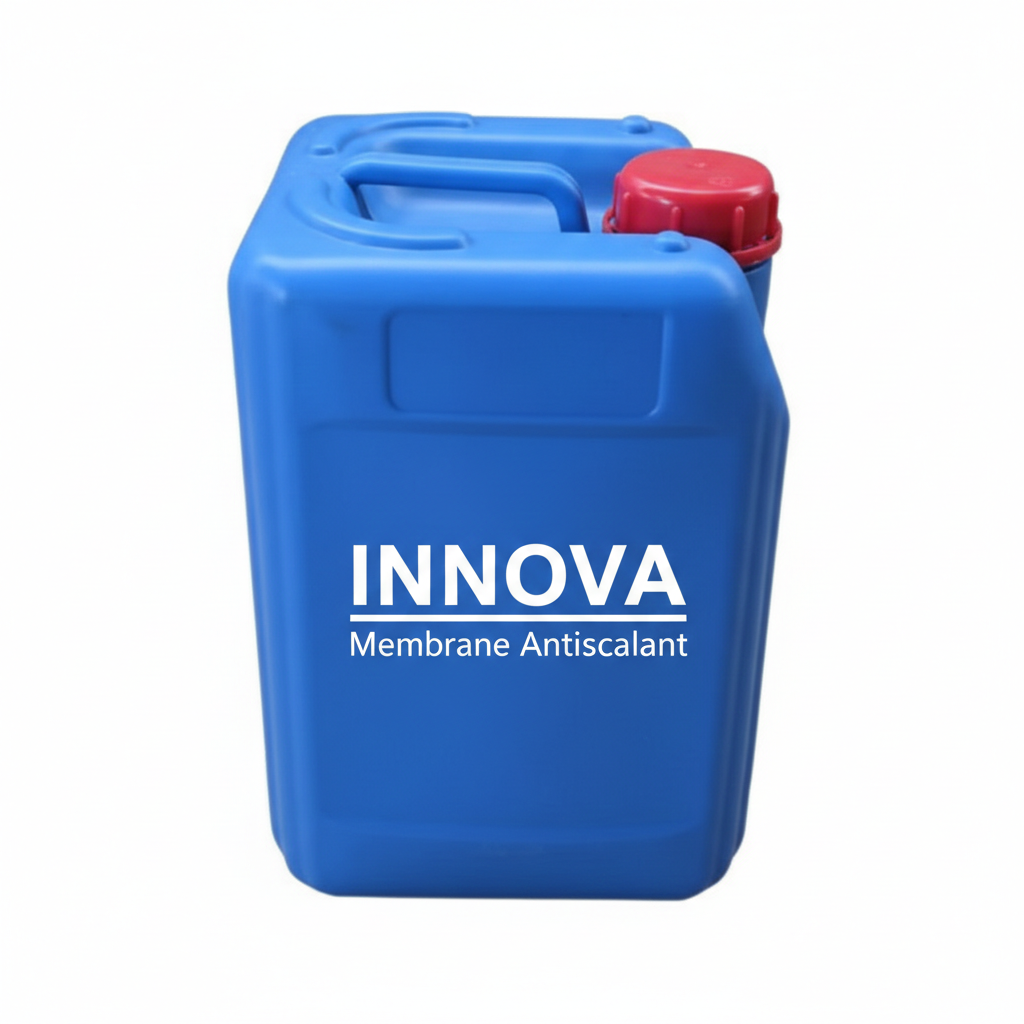
Universal RO Membrane Antiscalant & Antifoulant for Oman's SWRO, Brackish & Process Water Plants
Innova Corporate (India) manufactures a universal-grade membrane antiscalant in Oman designed for facilities that cannot afford to compromise on membrane life. From the SWRO trains at Barka and Ghubrah supplying Muscat's drinking water to the brackish RO units feeding industrial operations in Sohar Free Zone, Duqm SEZ, and Salalah Free Zone, our formulation keeps polyamide and TFC membranes clean across the full spectrum of Omani feed water conditions — high salinity, high hardness, elevated silica, and dissolved metals.
Our membrane antiscalant works as a super-threshold stabilizer. Instead of merely slowing down scale formation, it interferes with crystal nucleation and growth at the molecular level, keeping supersaturated salts dissolved well beyond their normal precipitation limits. For Omani plants, this means RO systems can run at higher recovery rates without risking the membrane fouling that forces frequent shutdowns and chemical cleanings. It eliminates the need for hazardous acid dosing — a significant safety improvement for operational teams across the Sultanate.
The formulation delivers broad-spectrum protection against every major foulant found in Oman's water sources: calcium carbonate, calcium sulphate, barium sulphate, strontium sulphate, magnesium sulphate, calcium fluoride, iron, and silica. Whether your plant draws from Gulf seawater near Sohar and Duqm, brackish aquifers in Al Batinah and the Interior, or produced water streams near Fahud and Yibal, this single formulation provides consistent performance across all of them.
Key Features & Strategic Benefits for Oman Operations:
- Enhanced System Recovery: Enables higher recovery ratios by maintaining clean membrane surfaces — critical for inland brackish plants in Al Batinah and the Interior where brine disposal is expensive.
- Broad-Spectrum Foulant Control: Single formulation handles carbonate, sulphate, fluoride, iron, and silica scaling simultaneously — ideal for Oman's complex feed water chemistry.
- Low Dosage Efficiency: Highly concentrated formula requires only 2–6 ppm typical dosing, keeping chemical costs predictable for Omani plants even at high flow rates.
- Phosphate-Free Performance: Unlike SHMP-based products, it does not cause calcium phosphate or iron phosphate deposition — a common problem in hard-water Omani aquifers.
- Extended CIP Intervals: Dramatically reduces cleaning frequency across SWRO, brackish and process water trains operating in Oman's industrial zones.
- Universal Membrane Compatibility: Safe with all polyamide, Thin-Film Composite (TFC), and cellulose acetate membranes — including Dow FilmTec, Toray, Hydranautics, LG, and Koch elements.
- Non-Hazardous Formulation: Stable, non-corrosive, and easy to handle — safer for operational staff at Oman facilities compared to acid-based alternatives.
- Khareef Season Stability: Maintains performance through Dhofar's monsoon months when feed water in Salalah experiences elevated turbidity, organics, and biological activity.
How Super-Threshold Stabilization Protects Oman RO Membranes
As water concentrates through an RO membrane, dissolved minerals pass their solubility limits and begin to crystallize. In Oman's high-TDS feed water — especially Gulf seawater above 40,000 ppm — this crystallization begins rapidly. Our antiscalant interferes at three critical stages: it prevents stable crystal nuclei from forming (threshold inhibition), distorts the shape of any crystals that do form so they cannot adhere to the membrane (crystal modification), and disperses existing fine particles so they exit through the concentrate stream (dispersion). This triple mechanism works continuously through the full length of the pressure vessel, protecting both the lead and tail elements in each RO array.
Universal Antiscalant vs SHMP & Standard Inhibitors: Oman Comparison
| Parameter | SHMP (Old Tech) | Standard Antiscalant | Innova Universal Antiscalant |
|---|---|---|---|
| Scale Types Covered | CaCO₃ only | CaCO₃, CaSO₄ | CaCO₃, CaSO₄, BaSO₄, SrSO₄, CaF₂, Fe, Silica |
| Phosphate Deposition Risk | High | Medium | None (phosphate-free) |
| Dosage (Typical) | 10–20 ppm | 4–8 ppm | 2–6 ppm |
| Acid Dosing Required | Yes | Sometimes | No |
| Membrane Compatibility | All types | TFC, Polyamide | TFC, Polyamide, CA |
| CIP Frequency (Oman SWRO) | Monthly | Every 6–8 weeks | Quarterly or longer |
Case Study: Brackish RO Plant in Al Batinah
A brackish water RO facility in the Al Batinah region was treating 5,800 ppm TDS groundwater with elevated calcium, sulphate, and 1.8 ppm dissolved iron. The plant was running a general-purpose antiscalant but still required membrane cleaning every 4 weeks, with permeate flow declining 18% between cleanings. After switching to Innova's universal membrane antiscalant at 4 ppm dosing, the facility reported CIP frequency extended to every 13 weeks, normalized permeate flow sustained throughout the cleaning cycle, and annual chemical + labor savings exceeding 45% compared to the previous program. The plant now operates continuously through peak summer demand without membrane-related shutdowns.
Frequently Asked Questions — Universal Membrane Antiscalant in Oman
Q1: What makes a "universal" membrane antiscalant different from a standard one?
A universal antiscalant handles the full spectrum of foulants — carbonate, sulphate, fluoride, iron, and
silica — in a single formulation. Standard antiscalants cover only carbonate and some sulphate. For Oman's
varied water sources (Gulf seawater, inland brackish, produced water), a universal formulation avoids the
need to stock and switch between multiple products.
Q2: Can this replace acid dosing in our Oman RO plant?
Yes. Because the formulation is a super-threshold stabilizer, it keeps supersaturated salts dissolved
without pH adjustment. This eliminates the safety and corrosion risks of handling sulfuric or hydrochloric
acid — a major operational improvement for plants in Oman's hot climate where acid handling adds
significant risk.
Q3: Is it compatible with cellulose acetate membranes used in older Oman plants?
Yes. Unlike many modern antiscalants that work only with TFC and polyamide membranes, our universal
formulation is also safe for cellulose acetate (CA) membranes. This is useful for older desalination and
industrial RO units still operating in parts of Oman.
Q4: Do you provide free water analysis and dosing support for Oman clients?
Yes. We review your feed water analysis (TDS, hardness, sulphate, silica, iron, pH, temperature, and
recovery) and provide a free dosing recommendation tailored to your plant. Ongoing technical support is
available for all Oman facilities we supply — including adjustments during Khareef season or when feed
water quality changes.
Storage & Stability: Store in original, tightly sealed containers in a cool, dry area away from direct sunlight and heat sources at your Oman facility. Keep away from open flames. Do not allow the product to freeze. For detailed handling protocols, shelf life, and safety information, please refer to our Material Safety Data Sheet (MSDS) and Technical Data Sheet (TDS).