- 2B / BW Shalimar Bagh, Opp. BQ Market, Near DLF Mall New Delhi - 110088, India.
- :+91-9312-871-070

Manufacturers, Exporters, Suppliers of Antiscalant For Sea Water Desalination
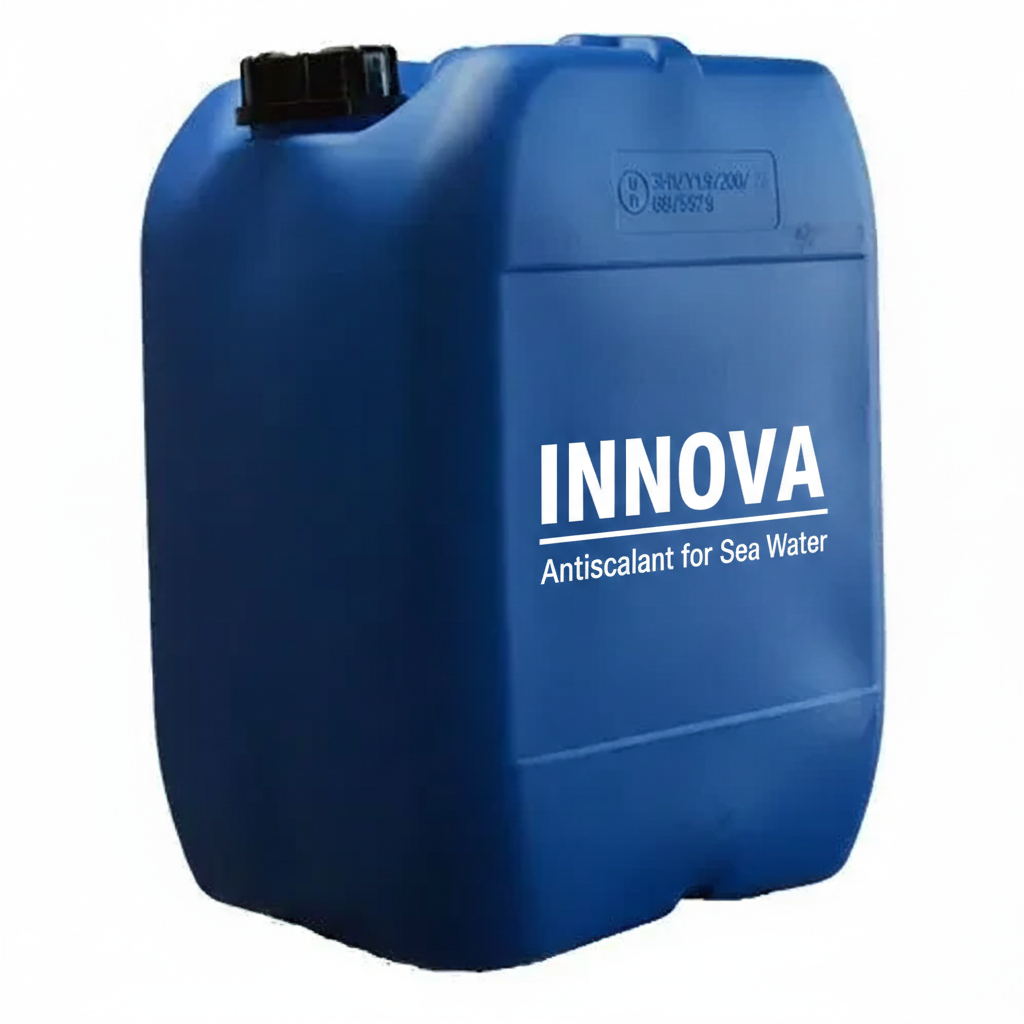
High-Efficiency Antiscalant for Seawater Desalination in Qatar's SWRO & IWPP Plants
Given Qatar's near-total reliance on the sea for fresh water — over 99% of the country's municipal supply comes from desalination — Innova Corporate (India) provides advanced antiscalant for seawater desalination in Qatar. Our product is specifically engineered to prevent tough inorganic scaling in the high-pressure seawater RO systems operating along Qatar's coastline, from the massive IWPP complexes at Ras Laffan and Mesaieed to the desalination facilities serving Doha, Al Khor and Dukhan. It performs reliably under the high-salinity, high-temperature conditions that define the Persian Gulf — one of the most demanding seawater environments in the world for membrane-based desalination.
This specialty chemical is vital for Qatar's municipal and industrial desalination plants, ensuring consistent freshwater output for the city of Doha and beyond. With Qatar's population and industrial base continuing to expand under the Qatar National Vision 2030, water security depends entirely on keeping these SWRO and thermal desalination plants operating at peak efficiency. Our antiscalant protects the expensive membrane elements from irreversible fouling — preserving both the capital investment and the operational reliability that Qatar's water security relies on. Choosing our desalination-grade antiscalant gives Qatar businesses and utilities the highest level of protection for their most vital water assets.
The product is specifically effective in environments with very high TDS — Persian Gulf seawater routinely exceeds 45,000 ppm total dissolved solids, with elevated sulphate, barium, strontium and carbonate concentrations that cause rapid scaling in poorly protected systems. Our antiscalant keeps these mineral salts in solution through the full length of the membrane train, ensuring that permeate flow remains consistent even under the rigorous operating conditions of Qatari summers when feed water temperatures climb above 35°C. It significantly reduces the frequency of acid CIP cycles, extending the operational lifespan of the expensive SWRO membranes deployed across Qatar's coastal desalination fleet.
Key Features & Strategic Benefits for Qatar SWRO Facilities:
- Persian Gulf Water Optimized: Specifically formulated for Gulf seawater with 45,000+ ppm TDS and elevated sulphate/barium/strontium content, the most aggressive scaling environment in the region.
- IWPP-Ready Performance: Engineered for the demanding operational profile of Qatar's Independent Water and Power Plants at Ras Laffan and Mesaieed.
- High-Temperature Stability: Maintains effective scale inhibition through Qatar's peak summer conditions when feed water temperatures exceed 35°C.
- Broad-Spectrum Scale Control: Handles calcium carbonate, calcium sulphate, barium sulphate, strontium sulphate, magnesium hydroxide and silica dispersion simultaneously.
- High Recovery Support: Enables SWRO operation at elevated recovery rates — critical for maximizing freshwater output at Qatari desalination facilities facing growing demand.
- CIP Frequency Reduction: Extends intervals between acid cleanings, reducing chemical, labor and downtime costs for Qatar water producers.
- Phosphino-Carboxylic Chemistry: Advanced active ingredient combined with silica dispersants outperforms older phosphonate-only formulations — particularly in the challenging Persian Gulf water chemistry.
- Membrane Compatibility: Safe with all major TFC and polyamide SWRO membranes deployed across Qatar's desalination sector, including Dow FilmTec, Toray, Hydranautics, LG and Koch elements.
Why Persian Gulf Seawater Needs a Different Antiscalant Than Open Ocean Water
Persian Gulf seawater is chemically distinct from typical open ocean water. TDS runs 15–20% higher, sulphate concentrations are elevated, and the water naturally carries more barium and strontium. Combined with summer water temperatures that routinely exceed 35°C, these factors accelerate scaling kinetics significantly compared to Atlantic or Pacific seawater. At the concentration factors typical of SWRO operation (4x to 5x), calcium sulphate and barium sulphate can exceed their solubility limits by wide margins if the antiscalant is not specifically designed for these conditions. Standard brackish-grade or open-ocean-grade antiscalants simply cannot maintain stability in this regime — the chemistry has to be different. Our formulation is built from the ground up for the Gulf's specific ionic profile and thermal conditions, which is why IWPP operators at Ras Laffan and Mesaieed, and municipal desalination facilities serving Doha and Al Khor, choose it for their most demanding trains.
Technical Specifications for Qatar Projects
| Parameter | Value / Description |
|---|---|
| pH (as such) | 9.0 to 10.0 |
| Appearance | Pale Yellow Liquid |
| Water Solubility | Completely Soluble |
| Solid Content | 33% to 34% w/w |
| Specific Gravity | 1.17 to 1.23 |
| Chemical Composition | Functional phosphino carboxylic acid with advanced silica dispersants |
| Recommended Dose (Qatar SWRO) | 3 – 6 ppm |
| Max Feed Water Temperature | Up to 45°C |
Case Study: SWRO Facility Near Mesaieed Industrial City
A 15,000 m³/day SWRO facility near Mesaieed Industrial City was operating with a general-purpose antiscalant at 4 ppm dosing but experiencing CIP cycles every 5 weeks and measurable flux decline across summer months. Feed water from the Persian Gulf showed 46,000 ppm TDS, 3,600 ppm sulphate, and pH 8.2. The plant also had recurring barium sulphate scaling on first-stage membranes, requiring acid cleaning that only partially restored performance. After switching to Innova's seawater-specific antiscalant at 5 ppm, the facility reported CIP intervals extended from 5 weeks to 13 weeks, complete elimination of barium sulphate issues, and stable normalized permeate flow through two consecutive Qatari summers. Specific energy consumption dropped by 9% due to reduced feed pressure requirements — translating to significant savings at the plant's continuous duty cycle. The plant has since standardized the formulation across its sister facility in Ras Laffan.
Frequently Asked Questions — Seawater Antiscalant in Qatar
Q1: Why can't I use a standard brackish water antiscalant in my Qatar SWRO plant?
Brackish antiscalants are designed for lower TDS and lower scaling potential. When applied to
Persian Gulf seawater with 45,000+ ppm TDS, they lose effectiveness at the high concentration
factors of SWRO operation. Calcium sulphate and barium sulphate in particular can exceed solubility
limits by wide margins, causing rapid scaling that brackish-grade chemistry cannot prevent. SWRO
in Qatar requires an antiscalant specifically formulated for high-sulphate, high-barium seawater
conditions.
Q2: How does temperature affect dosing in Qatar's summer months?
Feed water temperature in the Persian Gulf can exceed 35°C in peak summer, increasing both scale
formation kinetics and membrane permeability. Under these conditions, calcium carbonate scaling
potential increases and some antiscalants become less effective. Our formulation is stable up to
45°C, providing consistent protection through Qatar's hottest months without requiring dosage
reduction or increased cleaning frequency.
Q3: Is this product compatible with the membranes used in Qatar's IWPP plants?
Yes. The formulation is compatible with all major TFC and polyamide SWRO membranes used across
Qatar's desalination sector, including products from Dow FilmTec, Toray, Hydranautics, LG and Koch.
No membrane warranty is affected when the product is used per our dosing recommendations.
Q4: Do you supply seawater antiscalant across Qatar's IWPP and industrial SWRO plants?
Yes. We supply across Qatar including Ras Laffan, Mesaieed, Doha, Al Khor, Dukhan, Al Wakrah,
Al Rayyan and all coastal desalination sites. Standard packaging of 25 kg, 250 kg and 1000 kg IBC
is available with regular dispatch from India to Hamad Port and other Qatari ports. Bulk pricing
and consolidated shipments are available for large-scale water and power producers.