- 2B / BW Shalimar Bagh, Opp. BQ Market, Near DLF Mall New Delhi - 110088, India.
- :+91-9312-871-070

Manufacturers, Exporters, Suppliers of RO Dechlorination Chemicals
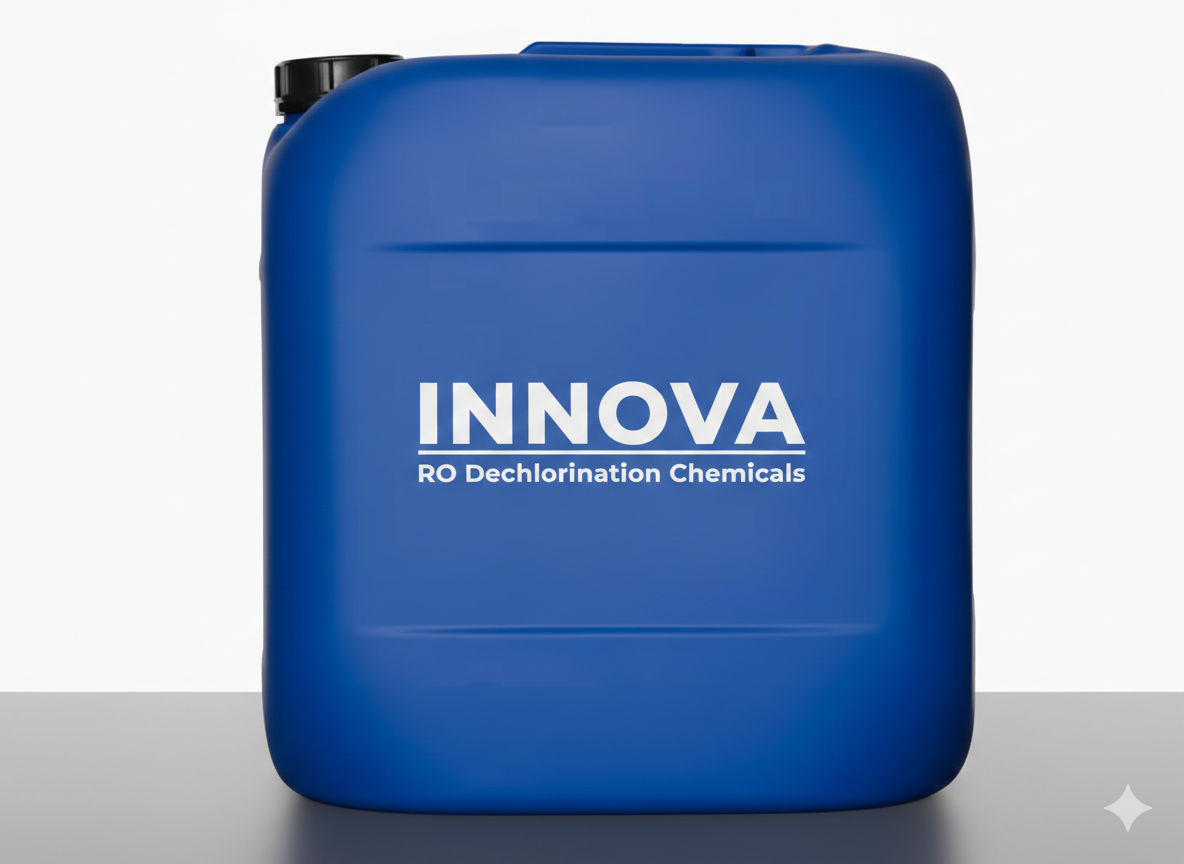
RO Dechlorination Chemicals for Qatar's SWRO, IWPP & Industrial Plants (Stabilized Liquid Oxidizing Agent Neutralizer)
Innova Corporate (India) is a leading manufacturer, supplier and exporter of high-grade RO dechlorination chemicals in Qatar. Residual chlorine can cause irreversible damage to sensitive Thin Film Composite (TFC) and Polyamide membranes — the two membrane types used in nearly every SWRO and IWPP plant across Qatar's desalination fleet. Our specialized liquid de-chlorinator is formulated to rapidly neutralize free chlorine in Qatar's water systems, ensuring total membrane safety and operational longevity for the country's desalination and industrial plants. From the massive IWPP complexes on the Gulf coast to the industrial facilities serving Qatar's growing manufacturing base, our formulation provides the reliable chlorine removal that water infrastructure depends on.
Our RO de-chlorinator in Qatar is a concentrated, stabilized liquid designed for the complete elimination of residual chlorine prior to the RO system. By removing strong oxidizing agents from the feed water, it prevents membrane degradation — maintaining the salt rejection performance and permeate flow rate of your water treatment plant through every season. Qatar's warm climate accelerates chlorine decay kinetics in some ways but also increases the risk of partial dechlorination if dosing is not precise — making the stabilized liquid formulation a clear advantage over traditional powder sulfite products that lose activity in storage and require careful mixing.
Key Features & Strategic Benefits for Qatar Industries:
- Rapid Neutralization: Stabilized formula ensures near-instant action in neutralizing free chlorine in the feed water — critical for continuous SWRO operation at Qatari desalination plants.
- Critical Membrane Protection: Guards polyamide and TFC membranes against oxidative degradation and chemical "burning" in Qatar's treatment facilities — the two membrane types used across all major SWRO plants in the country.
- Liquid Precision: Unlike conventional powders, our liquid formula is easy to handle, store and dose with high accuracy at your Qatar site — no mixing time, no caking, no activity loss from moisture exposure.
- Enhanced Stability: Significantly more stable and effective than traditional sodium bisulfite solutions, which oxidize in storage and lose potency over time.
- System Longevity: Prevents premature membrane replacement costs by shielding against chlorine attack — a major saving for Qatar plants where membrane replacement involves significant capital and downtime.
- High-Temperature Stability: Performs reliably through Qatar's summer months when feed water temperatures exceed 35°C — chlorine decay kinetics increase, but our stabilized formula maintains consistent neutralization.
- Universal Compatibility: Compatible with all major TFC and polyamide SWRO membranes deployed across Qatar's desalination sector, including Dow FilmTec, Toray, Hydranautics, LG and Koch elements.
- Bulk Supply: Available in 25 kg, 250 kg and 1000 kg IBC packaging — suitable for large-scale IWPP operations and multi-site industrial facilities.
Why Dechlorination Is Non-Negotiable for Qatar SWRO Plants
Many SWRO and IWPP plants in Qatar use chlorination upstream as a pretreatment biocide — dosing hypochlorite into the intake to control marine biological growth in pipelines and pretreatment equipment. This is an effective strategy for controlling marine fouling, but it comes with a critical condition: the chlorine must be completely removed before the water reaches the RO membranes. Polyamide TFC membranes tolerate essentially zero free chlorine. Even 0.1 ppm residual over weeks of continuous exposure causes measurable salt rejection loss, and higher concentrations can degrade elements permanently within days. The chemical mechanism is straightforward: chlorine oxidizes the polyamide active layer, breaking the polymer chains that provide salt rejection. Once this damage occurs, it cannot be reversed by cleaning or any other intervention — the membrane must be replaced. For Qatar's IWPPs, where a single SWRO train can contain hundreds of membrane elements, the cost of a chlorine breakthrough incident runs into millions of riyals. Dechlorination is not just a chemical process — it is the primary safeguard against one of the most expensive failure modes in desalination.
Liquid Dechlorinator vs Powder Sodium Bisulfite: Qatar Comparison
| Parameter | Powder Sodium Bisulfite | Innova Liquid Dechlorinator |
|---|---|---|
| Storage Stability | Oxidizes in storage | Stable for 12+ months |
| Dosing Accuracy | Manual, variable | Precise pump-based |
| Mixing Required | Yes — time & labor | None — ready to use |
| Activity Consistency | Variable with age | Consistent batch to batch |
| Response Time | Minutes (after mixing) | Near-instant |
| Handling Safety | Dust inhalation risk | Liquid — no dust |
| Breakthrough Risk | Higher | Minimal |
Case Study: SWRO Facility in Ras Laffan Industrial City
A 20,000 m³/day SWRO facility in Ras Laffan Industrial City was using sodium metabisulfite powder for chlorine neutralization but experiencing recurring problems: inconsistent chlorine removal due to powder aging, occasional chlorine breakthrough events detected by ORP monitoring, and premature salt rejection decline on the first-stage membranes after 18 months of service. The facility switched to Innova's stabilized liquid dechlorinator with automated dosing based on feed ORP feedback. Over the next 14 months, chlorine breakthrough events dropped to zero, ORP remained stable within the target range across all operating conditions — including two peak summer periods when feed water temperatures exceeded 36°C — and the replacement membrane set retained >99.5% salt rejection throughout. The facility also reported simplified inventory management with one liquid product replacing two powder SKUs, and safer handling for plant operators. The plant has since expanded the dechlorination program to two sister facilities in the Mesaieed Industrial City and Dukhan areas.
Application & Dosage Guidelines for Qatar:
The dosage depends on residual chlorine levels and contact time. Typically, the dosage ranges from 3 ppm to 15 ppm for Qatar water conditions, adjusted based on continuous ORP or periodic DPD measurements at the RO feed.
- Injection Point: Should be dosed as close to the RO system as possible (e.g., before cartridge filters) to minimize the time between dechlorination and membrane exposure.
- High Chlorine Strategy: If free chlorine is high, dose de-chlorinator prior to antiscalant injection, as chlorine can neutralize the effectiveness of antiscalants.
- Safe Mixing: Avoid mixing neat (concentrated) de-chlorinator and antiscalant directly; ensure dosing points are properly spaced in your Qatar plant setup.
- Monitoring: Continuous ORP monitoring is recommended for large IWPP installations; periodic DPD testing is sufficient for smaller industrial plants.
Frequently Asked Questions — RO Dechlorination in Qatar
Q1: How do I know if my Qatar RO plant has a chlorine breakthrough problem?
The most reliable indicator is ORP monitoring at the RO feed — if ORP exceeds 200 mV, some chlorine
is likely reaching the membranes. Periodic DPD testing can confirm actual free chlorine concentration.
Symptoms of chlorine damage include declining salt rejection (rising permeate TDS) that does not
respond to cleaning, and gradual but irreversible flux loss. If your plant is seeing these patterns,
a membrane autopsy or performance review is recommended.
Q2: Can I switch from powder sodium bisulfite to liquid dechlorinator in my Qatar plant?
Yes, and many Qatar facilities have done so. The switch typically involves replacing the powder
mixing system with a dosing pump plumbed into the feed line, then calibrating the dose based on
feed ORP or DPD measurements. The transition is straightforward and typically pays for itself
within months through reduced chemical waste, lower labor requirements and eliminated breakthrough
risk.
Q3: Does temperature affect dechlorination performance in Qatar?
Yes — chlorine decay kinetics are faster at higher temperatures, but so is the reaction rate with
our dechlorinator. This means that the dechlorination reaction itself becomes faster in summer, but
the risk of under-dosing is also higher if dosing is not adjusted. Our formulation's high stability
and precise pump-based dosing ensure consistent neutralization across Qatar's full temperature range,
without requiring frequent re-calibration.
Q4: Do you supply RO dechlorination chemicals across Qatar?
Yes. We supply across Qatar including Doha, Ras Laffan, Mesaieed, Al Khor, Dukhan, Al Wakrah and
Al Rayyan. Standard packaging of 25 kg, 250 kg and 1000 kg IBC is available with regular dispatch
from India to Hamad Port and other Qatari ports. Bulk pricing and consolidated shipments are
available for multi-site industrial and municipal operators.
Handling & Safety Measures:
Always wear proper safety gear, including splash goggles, lab coats, chemical-resistant gloves and vapor respirators. In case of skin contact, wash immediately with plenty of water and remove contaminated clothing. For eye contact, flush with fresh water for at least 15 minutes and seek medical attention. Store in original containers in a cool, dry place at your Qatar facility, away from direct sunlight, heat sources and incompatible oxidizers. Do not allow the product to freeze. Refer to the MSDS for comprehensive safety data specific to your application.
*Note: As a company policy, Innova Corporate recommends consulting our service engineers in Qatar for precise dosage requirements based on your specific water chemistry. Free consultation is provided for all Qatar clients, including water analysis review, ORP monitoring setup guidance and application-specific dosing recommendations.