- 2B / BW Shalimar Bagh, Opp. BQ Market, Near DLF Mall New Delhi - 110088, India.
- :+91-9312-871-070

Manufacturers, Exporters, Suppliers of High Silica RO Antiscalant
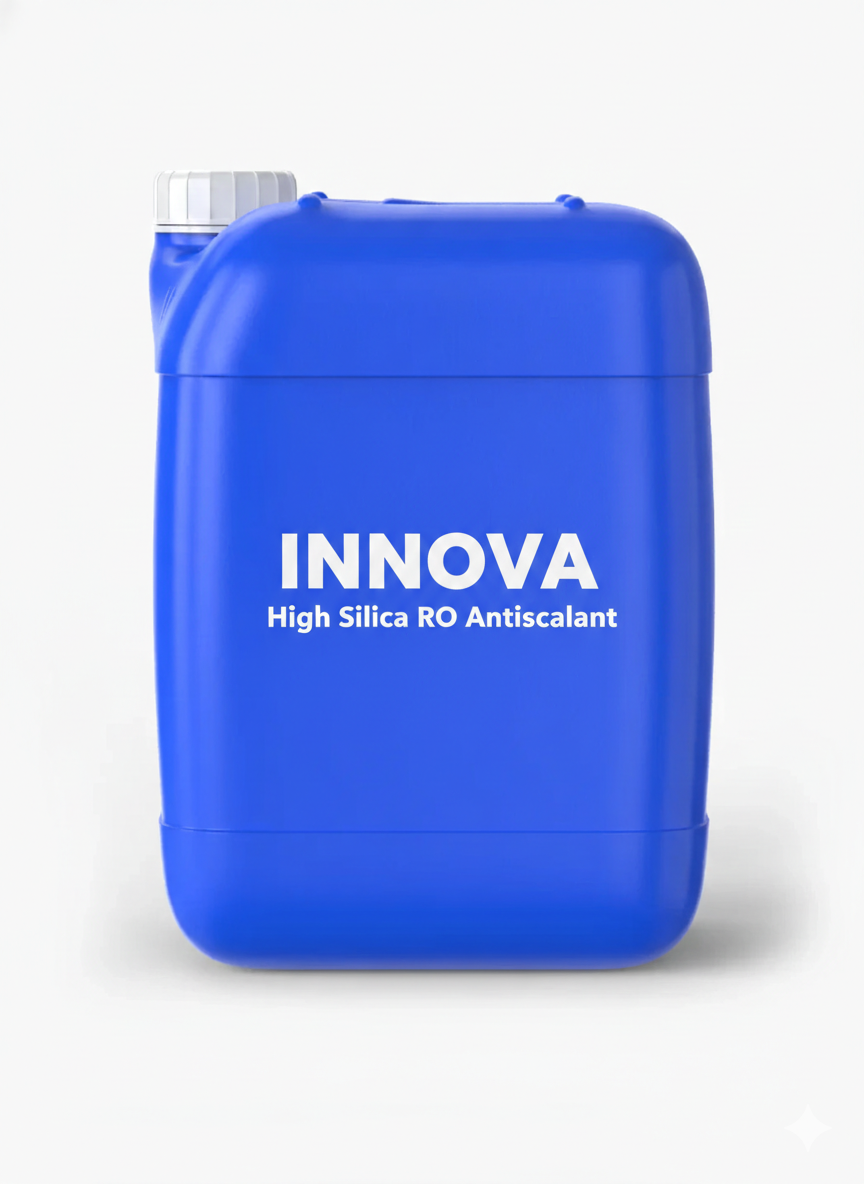
High Silica RO Antiscalant for Qatar's Energy, District Cooling & Industrial Plants (Extreme Scale Control)
Manage complex silica challenges in Qatar's industrial water supply with our high silica RO antiscalant in Qatar. Innova Corporate (India) provides this specialty product for Qatar's energy and district cooling sectors — two industries where silica scaling can severely limit water recovery and compromise cooling efficiency. District cooling networks serving Doha's commercial towers and the energy sector's process water systems both depend on reliable RO treatment, and both face elevated silica loads that standard antiscalants cannot handle. Our formulation keeps silica in a soluble state, preventing the formation of the hard, glass-like scales that threaten RO membranes across Qatar.
By preventing silica scale, this chemical allows Qatar industrial plants to operate safely at higher recovery levels — crucial for water conservation in an arid country where every cubic meter matters. It is an indispensable solution for Qatar's sustainable water management strategy, ensuring that expensive reverse osmosis membranes are protected in the Qatar market. The formulation works reliably across the temperature range typical of Qatar's district cooling and industrial operations, from ambient conditions to the 35°C+ feed water temperatures encountered during peak summer months.
Key Features & Strategic Benefits in Qatar:
- Extreme Silica Inhibition: Effectively controls silica scales up to 325 ppm in the concentrate stream — the highest performance threshold available for Qatar's most challenging industrial water sources.
- Iron Sequestration: Advanced formula prevents iron fouling — a common issue in Qatar water where industrial process sources and certain brackish aquifers carry dissolved iron that compounds silica scaling problems.
- High Recovery Rates: Allows systems to operate at higher recovery levels without compromising membrane integrity — critical for district cooling and energy sector operations where water efficiency directly affects operating costs.
- Broad Spectrum Efficiency: Works across a wide range of pH, TDS and high SDI water in Qatar — providing reliable performance regardless of seasonal feed water variations.
- Cost Optimization: Low dosage requirements (2 ppm to 20 ppm) result in significant operational savings — keeping chemical costs predictable even at high flow rates.
- Environmental Safety: Completely organic, biodegradable and compatible with all membrane types — aligned with Qatar National Vision 2030 sustainability goals.
- High-Temperature Stability: Maintains full silica inhibition through Qatar's peak summer conditions when feed water temperatures exceed 35°C.
- Full Program Integration: Works seamlessly alongside our antiscalants, biocides and other RO chemicals — no interference with downstream treatment chemistry.
Why Qatar's Energy & District Cooling Sectors Need Extreme Silica Control
Qatar's district cooling networks and energy sector facilities share a common operational challenge: they treat large volumes of water in continuous duty cycles where silica scaling risk is amplified by high recovery rates. District cooling plants in particular push RO systems to maximum recovery because the volume of cooling water required is enormous and every percentage point of recovery translates to significant water and cost savings. At high recovery, silica in the feed water concentrates past its solubility limit, polymerizes into glass-like deposits, and permanently damages membranes if not prevented. Standard antiscalants fail in this regime. Our high silica formulation was engineered specifically for this scenario — handling reject-side silica concentrations up to 325 ppm while maintaining full protection. For Qatar's district cooling operators and energy sector water treatment managers, this formulation enables the operational efficiency that modern facilities require.
Standard vs High Silica Antiscalant: Qatar Performance Comparison
| Parameter | Standard Antiscalant | Innova High Silica Antiscalant |
|---|---|---|
| Silica Control (Concentrate) | Up to 100 ppm | Up to 325 ppm |
| Silica Polymerization Prevention | Limited | Full inhibition |
| Iron Co-Control | Up to 1 ppm | Up to 5 ppm |
| pH Operating Range | 6 – 8 | 5 – 10 |
| Max Recovery (District Cooling) | Up to 65% | Up to 80% |
| CIP Frequency (High Silica Feed) | Every 2–3 weeks | Every 10–14 weeks |
| High-Temperature Performance | Reduced above 30°C | Full efficacy at 35°C+ |
Case Study: District Cooling Plant at Lusail City
A major district cooling facility within the Lusail City development was processing water with 68 ppm silica, 320 ppm calcium hardness and 1.2 ppm dissolved iron. The plant was running at only 60% recovery due to repeated silica scaling that standard CIP chemicals could not remove — one membrane set had to be replaced after just 16 months of operation, well short of the expected 5-year service life. After switching to Innova's high silica antiscalant at 8 ppm dosing, the facility safely increased recovery to 76%, extended membrane life past 3 years with no further replacements, and reduced CIP frequency from every 5 weeks to every 12 weeks. The plant now reports annual savings exceeding 45% in membrane replacement and cleaning costs. The parent company, which operates multiple district cooling facilities across Qatar, has since standardized the high silica formulation across its entire network, including plants serving the Qatar Free Zones and the Qatar Science & Technology Park areas.
Application & Dosage: For plants in Qatar, the product should be dosed directly into the RO feed water tank or line after pretreatment. The dosage typically ranges from 2 ppm to 20 ppm, depending on the specific water chemistry including calcium hardness, alkalinity and silica content. For water with high iron (0.5 to 1.0 ppm), a dosage of 5–7 ppm is recommended to ensure full stabilization. For combined high-silica and high-iron scenarios, dosing at 8–15 ppm provides complete protection. Our technical team provides free dosage recommendations based on your specific Qatar feed water analysis.
Frequently Asked Questions — High Silica Antiscalant in Qatar
Q1: Why is silica a bigger challenge for district cooling plants than for other RO systems?
District cooling plants operate at higher recovery rates because water efficiency directly impacts
their operating economics. Higher recovery means higher silica concentration in the reject stream,
which accelerates the polymerization reaction. Standard antiscalants lose effectiveness in this
regime. Our high silica formulation is specifically designed for the high-recovery operating
profile of Qatar's district cooling networks.
Q2: Can this antiscalant handle combined silica and iron fouling?
Yes. The formulation provides dual-action protection — silica polymerization inhibition plus iron
sequestration — in a single product. This matters for Qatar plants where industrial process water
and certain brackish sources carry both foulants. The combined protection eliminates the need
for a second chemical injection point.
Q3: What is the maximum silica level this product can handle in Qatar water?
Our high silica antiscalant is effective at feed-side silica levels up to 120 ppm and concentrate-side
concentrations up to 325 ppm. This covers the most demanding industrial and district cooling water
sources in Qatar. For extreme scenarios, dosage adjustment or combination with other treatment
approaches may be required — our team advises based on your specific water analysis.
Q4: Do you supply high silica antiscalant across Qatar?
Yes. We supply across Qatar through Hamad Port, with delivery to Doha Port, Al Ruwais Port and
Ras Laffan Port, plus all major industrial zones including Mesaieed Industrial City, Ras Laffan
Industrial City, Qatar Free Zones and Qatar Economic Zones. Standard packaging of 25 kg, 250 kg
and bulk drums is available.
Storage & Stability: Store in original, tightly sealed containers in a cool and dry environment at your Qatar facility. Protect from direct sunlight and heat sources to maintain chemical potency. Do not allow the product to freeze. For detailed application guidelines and safety protocols, please refer to the Technical Data Sheet (TDS) and Material Safety Data Sheet (MSDS), or contact our technical team for free consultation.