- 2B / BW Shalimar Bagh, Opp. BQ Market, Near DLF Mall New Delhi - 110088, India.
- :+91-9312-871-070

Manufacturers, Exporters, Suppliers of Cleaner For Silica Fouled Membrane
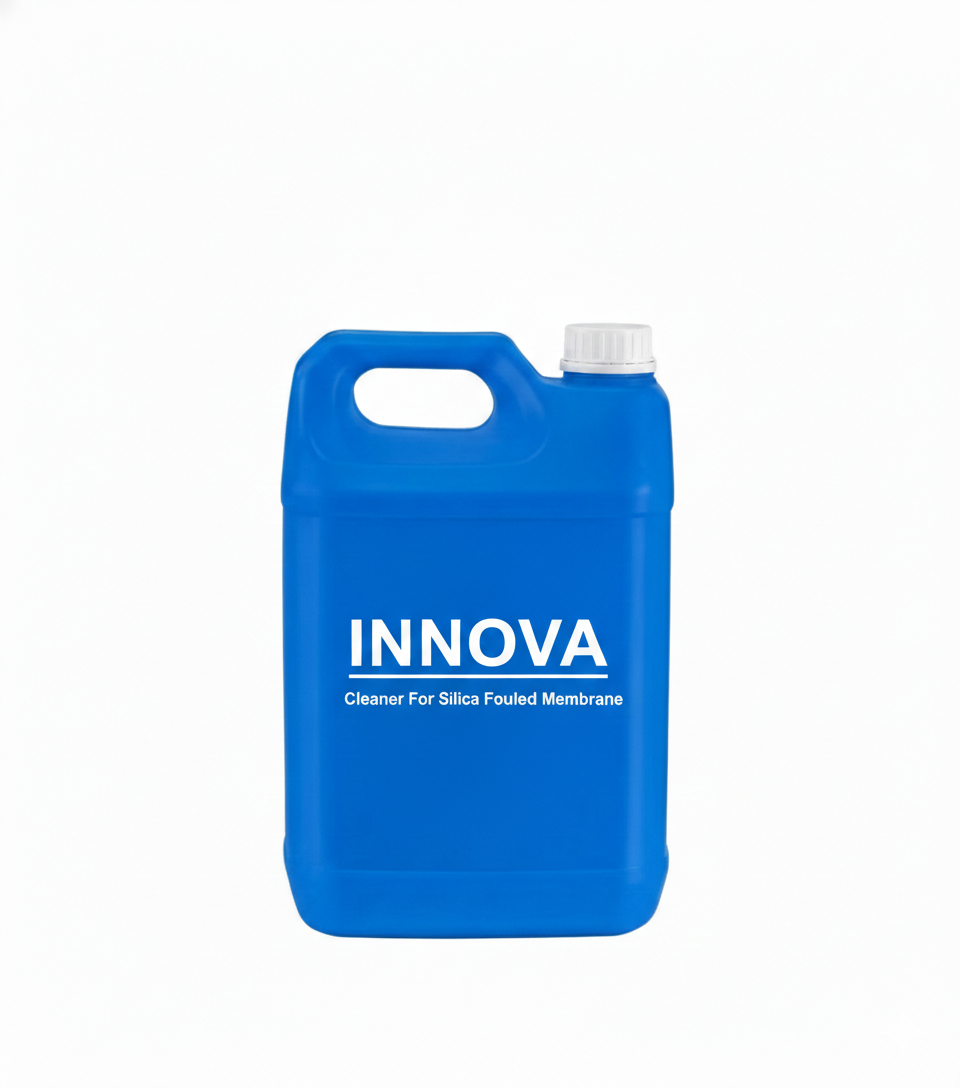
Advanced Silica Fouled Membrane Cleaner for Qatar's District Cooling, Petrochemical & Power Plants
Innova Corporate (India) offers a potent cleaner for silica fouled membrane in Qatar, specifically designed to remove the glass-like silica deposits that build up on RO membrane surfaces over time. In the arid environment of Qatar, silica can become a major limiting factor in water recovery for industrial plants — every percentage point of recovery concentrates silica further in the reject stream, accelerating the polymerization process that turns dissolved silica into immovable glass deposits. Our advanced cleaner is engineered to tackle these tough deposits and restore the permeability of membranes in Qatar's industrial and power facilities, including the district cooling networks and petrochemical complexes that depend on reliable process water.
By using our silica cleaner, Qatar-based industries can avoid permanent membrane damage and the high costs of replacement. This is particularly vital for the district cooling and petrochemical industries in Qatar, where continuous operation is critical and unexpected membrane failures cascade into production losses. Our cleaner ensures that RO systems in Qatar maintain their design flow rates even when dealing with the challenging water chemistry found in the Qatar region — from high-silica industrial process water to brackish aquifers with combined silica-iron loading.
Key Features & Strategic Benefits for Qatar Facilities:
- Polymerized Silica Dissolution: Breaks the siloxane (Si-O-Si) bonds that hold glass-like silica deposits together — something standard acid and caustic CIP cleaners cannot achieve.
- Membrane Recovery vs Replacement: Restores flux and rejection on elements that would otherwise need replacement — a major cost saving for Qatar plants operating with high-silica feed water.
- District Cooling Ready: Specifically engineered for the high-recovery operational profile of Qatar's district cooling networks, where silica concentration factors are highest.
- Petrochemical & Power Sector Compatible: Suitable for the demanding process water requirements of Qatar's petrochemical complexes and power generation facilities.
- Extended Membrane Life: Regular cleaning with our chemistry extends element service life by years in Qatar plants with chronic silica loading.
- Reduced Downtime: Fast-acting chemistry minimizes CIP cycle time, keeping plants running through Qatar's peak-demand summer periods.
- Compatible with Sequential CIP: Works effectively alongside standard high pH and low pH CIP cleaners — no interference with existing cleaning protocols.
- Safe for TFC & Polyamide: Fully compatible with all major thin-film composite, polyamide and cellulose acetate membranes used across Qatar.
- Technical Support Included: Free consultation with our Qatar technical team to determine the correct cleaning cycle and dosage for your specific water chemistry.
Why Silica Cleaning Is Different from Standard CIP in Qatar
Standard CIP chemistry for RO membranes is designed around two main foulant types: mineral scale (calcium carbonate, sulphate, iron oxide) removed by low pH acid cleaners, and organic/biological deposits (bio-slime, oils, algae) removed by high pH alkaline cleaners. Silica is neither. When silica exceeds its solubility limit in the RO concentrate stream, it polymerizes into an amorphous glass-like structure held together by strong siloxane (Si-O-Si) bonds. These bonds are chemically resistant to both acid and caustic attack. Qatar plants that don't use a dedicated silica cleaner often see gradually declining flux across successive CIP cycles — each standard cleaning removes the outer organic layer but leaves the silica underneath, which continues to build. Eventually the element becomes unfouling, and replacement is the only option. Our silica cleaner solves this by targeting the silica structure directly, allowing Qatar facilities in district cooling, petrochemical and power sectors to keep their membranes in service.
Standard CIP vs Silica-Specific Cleaner: Qatar Performance Comparison
| Parameter | Standard Acid CIP | Standard Caustic CIP | Innova Silica Cleaner |
|---|---|---|---|
| CaCO₃ Scale | Fully effective | Poor | Partial |
| Organic / Bio-slime | Poor | Fully effective | Partial |
| Polymerized Silica | Ineffective | Ineffective | Fully effective |
| Typical Recovery | 60 – 70% flux | 70 – 80% flux | 90 – 95% flux |
| Duration (per cycle) | 1 – 2 hours | 2 – 4 hours | 2 – 4 hours + soak |
| Application Focus | Industrial Qatar | District cooling | High-silica feed applications |
Case Study: Petrochemical Complex in Mesaieed Industrial City
A petrochemical facility in Mesaieed Industrial City operating a 25 m³/hr industrial RO plant was processing process water with 74 ppm silica and moderate hardness. Over 2 years of operation, the plant's normalized permeate flow had dropped by 31% despite regular CIP every 5 weeks using standard alkaline and acid cleaners. Two of the lead elements had been classified as permanently fouled, and the facility was preparing a full membrane replacement. As a final option before replacement, the plant ran a single CIP cycle with Innova's silica-specific cleaner. Post-cleaning performance analysis showed 90% of original flux restored on the affected elements, salt rejection recovered to within 0.4% of design, and differential pressure returned to baseline. The facility avoided the planned membrane replacement, adopted silica cleaning as part of its regular CIP sequence every 5 months, and has been operating without flux decline since. The operator has referred the product to two sister petrochemical facilities within the same industrial city.
Application & Dosage: We recommend consulting with our technical representatives to determine the most effective cleaning cycle and dosage for your specific water chemistry in Qatar. Every facility has different silica concentrations, membrane configurations and historical fouling profiles. Typical application involves a working solution recirculated through the membrane system for 2–4 hours at controlled temperature, followed by soaking and rinse steps. By utilizing our membrane cleaning chemicals correctly, plants can significantly reduce operational downtime and avoid the high costs of premature membrane replacement in their facility.
Frequently Asked Questions — Silica Membrane Cleaner in Qatar
Q1: Can permanently fouled membranes really be recovered with this cleaner?
In many cases, yes. Membranes classified as "permanently fouled" by conventional standards often
have a thick polymerized silica layer on the surface that masks the active layer underneath. When
that silica layer is dissolved by our cleaner, the underlying membrane is frequently still
functional. Not every fouled element will be recoverable, but the cost of trying is small compared
to premature replacement.
Q2: How is this different from your high silica antiscalant?
The antiscalant is used continuously during RO operation to prevent silica from polymerizing in the
first place. The silica cleaner is a CIP chemical used during scheduled maintenance to remove silica
that has already deposited. Both have their role: for new plants, antiscalant prevention is the
priority; for existing plants with silica fouling, the cleaner restores performance so an
antiscalant program can then maintain it. Many Qatar plants use both.
Q3: Does it work on both SWRO and industrial membranes in Qatar?
Yes. The formulation is compatible with all major TFC, polyamide and cellulose acetate membranes
regardless of feed water source. While silica fouling is more common in industrial process water
and brackish applications, SWRO plants can also experience silica buildup in specific conditions,
and our cleaner is effective in those cases.
Q4: Do you supply silica membrane cleaner across Qatar?
Yes. We supply across Qatar through Hamad Port, with delivery to Doha Port, Al Ruwais Port and
Ras Laffan Port, plus all major industrial zones including Mesaieed Industrial City, Ras Laffan
Industrial City, Qatar Free Zones and Qatar Economic Zones. Standard packaging of 25 kg, 250 kg
and bulk drums is available.
Safety & Protocol: To maintain the highest safety standards during application in Qatar, personnel should wear industrial-grade splash goggles, lab coats, chemical-resistant gloves and boots. In the event of skin contact, wash immediately with plenty of water and remove contaminated clothing. For eye contact, flush thoroughly for at least 15 minutes and seek immediate medical attention. Handle in well-ventilated areas only. For comprehensive safety data, please refer to the Material Safety Data Sheet (MSDS).
Storage & Stability: For our clients in Qatar, this product should be stored in its original, hermetically sealed containers in a cool, dry location away from direct sunlight, heat sources and open flames. Do not allow the product to freeze. For detailed shelf-life information and application guidelines, please consult the Technical Data Sheet (TDS).