- 2B / BW Shalimar Bagh, Opp. BQ Market, Near DLF Mall New Delhi - 110088, India.
- :+91-9312-871-070

Manufacturers, Exporters, Suppliers of RO Antiscalant High pH
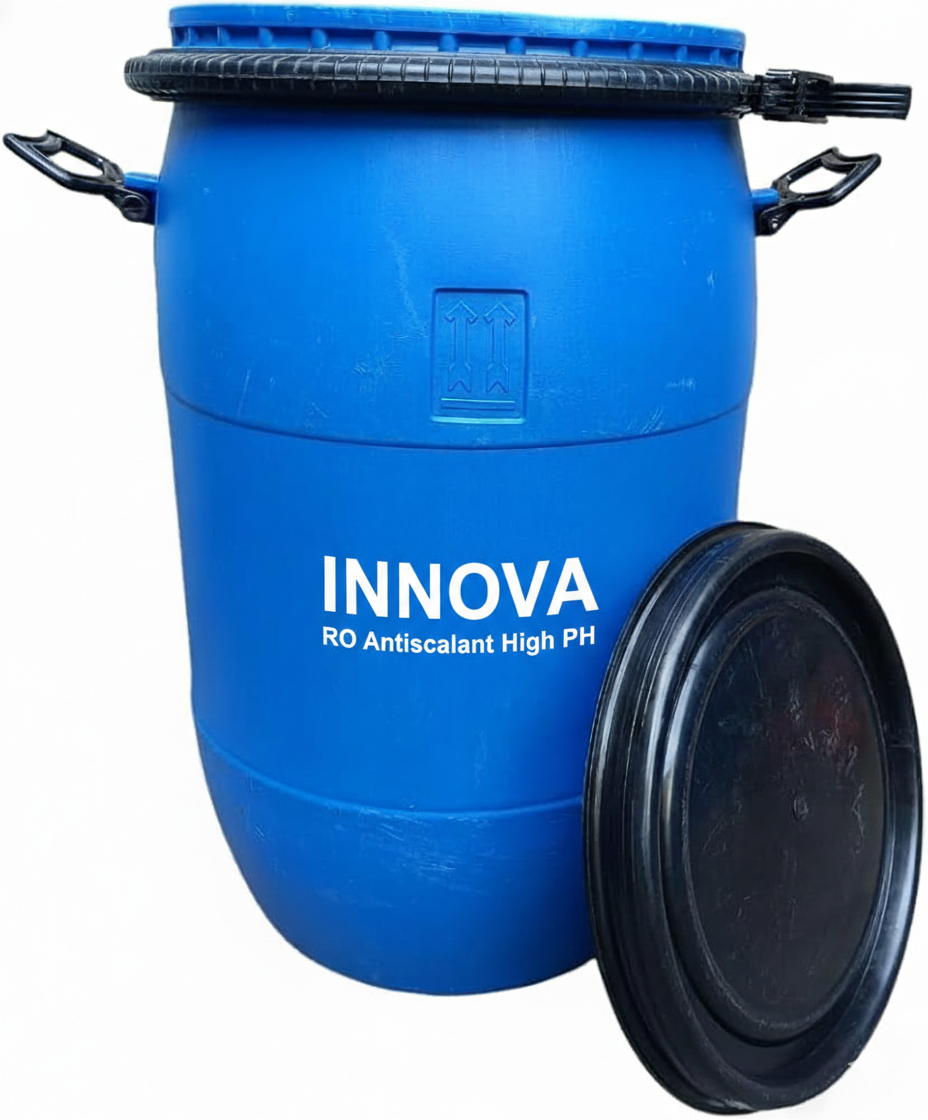
High pH RO Antiscalant for Qatar's High-Recovery SWRO & Industrial Plants (Super-Threshold Formula)
Innova Corporate (India) manufactures a high-performance high pH RO antiscalant in Qatar engineered for facilities pushing membrane systems to maximum recovery. Where standard antiscalants struggle to maintain stability at high concentration factors, this super-threshold formula keeps supersaturated salts dissolved well beyond their normal precipitation limits. For Qatar's SWRO plants and industrial RO facilities operating on high-salinity Gulf water, this translates directly into higher recovery, lower brine discharge, and reduced operational costs — critical advantages as the country continues to expand its desalination capacity.
The formulation is a dual-purpose chemical that functions as both a scale inhibitor and an alkalinity stabilizer. This is particularly valuable in Qatar, where many plants produce low-alkalinity permeate that would otherwise require separate pH adjustment. By handling both functions in a single injection point, the product simplifies plant chemistry, reduces equipment footprint, and cuts chemical handling overhead for Qatari operators. It also eliminates the need for hazardous acid dosing, delivering a safer work environment across the country's desalination and industrial facilities.
The formulation performs reliably under the demanding conditions of Qatar's water infrastructure: feed water with an LSI up to +2.6, silica levels up to 166 ppm, and iron concentrations up to 1.2 ppm in the reject stream. Whether your plant draws from the Persian Gulf, treats industrial process water, or processes brackish water for inland facilities, this single formulation provides consistent protection across the full range of Qatari feed water conditions — enabling the higher recovery rates that Qatar's water security strategy requires.
Key Features & Strategic Benefits for Qatar Facilities:
- Advanced Scale Inhibition: Controls calcium carbonate, calcium sulphate, barium sulphate, strontium sulphate, magnesium sulphate and calcium fluoride simultaneously — the full range of scales found in Qatar's high-salinity water.
- Dual-Action Chemistry: Functions as both a super-threshold scale inhibitor and an alkalinity builder — simplifying treatment programs for Qatar RO plants.
- Superior Iron Sequestration: Handles dissolved iron up to 1.2 ppm in reject — critical for industrial process water and brackish sources used across Qatar.
- High Silica Tolerance: Effective up to 166 ppm silica, covering the toughest brackish groundwater conditions encountered in Qatar's industrial operations.
- High-Recovery Enabler: Maintains stable membrane performance at elevated recovery rates — reducing brine volume and improving water efficiency for Qatar's SWRO fleet.
- Eco-Friendly Formulation: Fully organic and biodegradable, aligned with Qatar National Vision 2030 environmental sustainability goals.
- Low Dosage Economics: Concentrated formula requires minimal dosing, delivering cost savings for Qatar facilities operating at high flow rates.
- Wide Compatibility: Compatible with all major membrane brands and integrates cleanly with Innova's coagulant and flocculant range for full program flexibility.
High pH vs Neutral pH Antiscalant: When Qatar Plants Need Each
Not every RO plant needs a high pH antiscalant — but plants operating at high recovery with the wrong chemical program pay for it every day. Neutral pH antiscalants are the standard choice for typical SWRO and brackish RO, and they work well up to recovery rates of about 70–75%. Above that range, concentration factors increase rapidly, and both scale and pH instability become limiting. High pH antiscalants are specifically engineered to handle this regime. They maintain scale-inhibiting activity at higher concentration factors, and their alkaline chemistry buffers the low-alkalinity permeate that forms when RO strips out bicarbonate ions. For Qatar's desalination sector — where maximizing recovery from Gulf seawater directly reduces both energy costs and brine discharge — high pH antiscalant is the natural choice for pushing membrane performance to its design limits while maintaining reliable scale control.
Standard vs High pH Antiscalant: Qatar Performance Comparison
| Parameter | Standard (Neutral pH) | Innova High pH Antiscalant |
|---|---|---|
| Max Recovery (Brackish) | 70 – 75% | 80 – 85% |
| LSI Tolerance | Up to +1.8 | Up to +2.6 |
| Silica Tolerance | Up to 100 ppm | Up to 166 ppm |
| Iron Tolerance (Reject) | Up to 0.8 ppm | Up to 1.2 ppm |
| Permeate pH Support | None | Alkalinity building |
| Acid Dosing Required | Often yes | No |
| CIP Frequency (Industrial Qatar) | Every 6 – 8 weeks | Quarterly or longer |
Case Study: High-Recovery Industrial RO Plant Near Al Wakrah
A 60 m³/hr industrial RO plant near Al Wakrah was running at only 68% recovery due to repeated scaling problems with a standard neutral pH antiscalant. Feed water from a local brackish source contained 2,100 ppm TDS, 58 ppm silica, 0.9 ppm iron and had an LSI of +2.3. Attempts to push recovery above 72% caused rapid scaling and CIP was required every 5 weeks. After switching to Innova's high pH antiscalant at 4 ppm dosing, the plant safely increased recovery to 81%, extended CIP intervals to every 13 weeks, and eliminated the acid dosing step that had previously been required for pH control. The facility reported a 38% reduction in brine volume, an estimated 25% reduction in specific energy consumption, and annual chemical cost savings of over 30% compared to the previous program. The plant has since adopted the same formulation at a sister facility in the Al Rayyan industrial area.
Dosage & Application Guidelines for Qatar:
Our high pH antiscalant should be dosed directly into the RO feed water tank or line after pretreatment and before the cartridge filter. Dosage typically ranges from 1 ppm to 15 ppm, depending on feed water chemistry and operating conditions at your Qatar facility:
- Standard Conditions: 1 – 5 ppm for moderate hardness and TDS (typical for coastal SWRO and low-hardness industrial water).
- High Iron (0.5 – 1.0 ppm): Increase dosage to 10 – 15 ppm to stabilize both calcium and iron — typical for industrial process water and brackish groundwater sources.
- High Silica (Above 100 ppm): At 10 – 15 ppm dosing, the formula fully inhibits silica up to 166 ppm, common in brackish industrial wells.
- High Recovery Operation: 4 – 8 ppm for industrial plants targeting 80%+ recovery.
Frequently Asked Questions — High pH RO Antiscalant in Qatar
Q1: What is a "super-threshold" antiscalant and why does it matter in Qatar?
A super-threshold antiscalant keeps dissolved salts stable well beyond their normal solubility
limits — the "threshold" at which they would begin to crystallize. This matters in Qatar because
high-recovery RO operation concentrates feed water minerals to the point where standard threshold
inhibitors lose effectiveness. Our super-threshold formula maintains stability through that regime,
enabling higher recovery without scaling risk.
Q2: Does this antiscalant eliminate the need for separate alkalinity builder dosing?
In most Qatar applications, yes. The formulation provides alkalinity building as a secondary function,
eliminating the need for a separate injection point in many SWRO and industrial RO plants. Where
strict permeate pH targets are specified — for example, in potable water production — a separate
alkalinity builder may still be used for fine control. Our technical team advises on the optimal
configuration based on your plant specifications.
Q3: Is it compatible with my existing coagulants and flocculants?
Yes. The formulation is designed to work alongside Innova's coagulant and flocculant range without
chemical interference. It is also compatible with commonly used coagulants from other manufacturers,
though our technical team recommends reviewing the full pretreatment chemical program before
switching. Compatibility testing is available for larger Qatar facilities.
Q4: Do you supply high pH antiscalant across Qatar?
Yes. We supply across Qatar including Al Daayen, Al Shamal, Al Shahaniya, The Pearl, West Bay and
Msheireb. Standard packaging of 25 kg, 250 kg and 1000 kg IBC is available with regular dispatch
from India to Hamad Port and other Qatari ports.
Storage & Safety: Store in original, tightly sealed containers in a cool, dry place at your Qatar site. Keep away from direct heat, sunlight and incompatible oxidizers. Do not allow the product to freeze. For precise dosing calculations based on your feed water analysis, please refer to the Technical Data Sheet (TDS) and Material Safety Data Sheet (MSDS), or contact our experts specializing in Qatar water treatment.